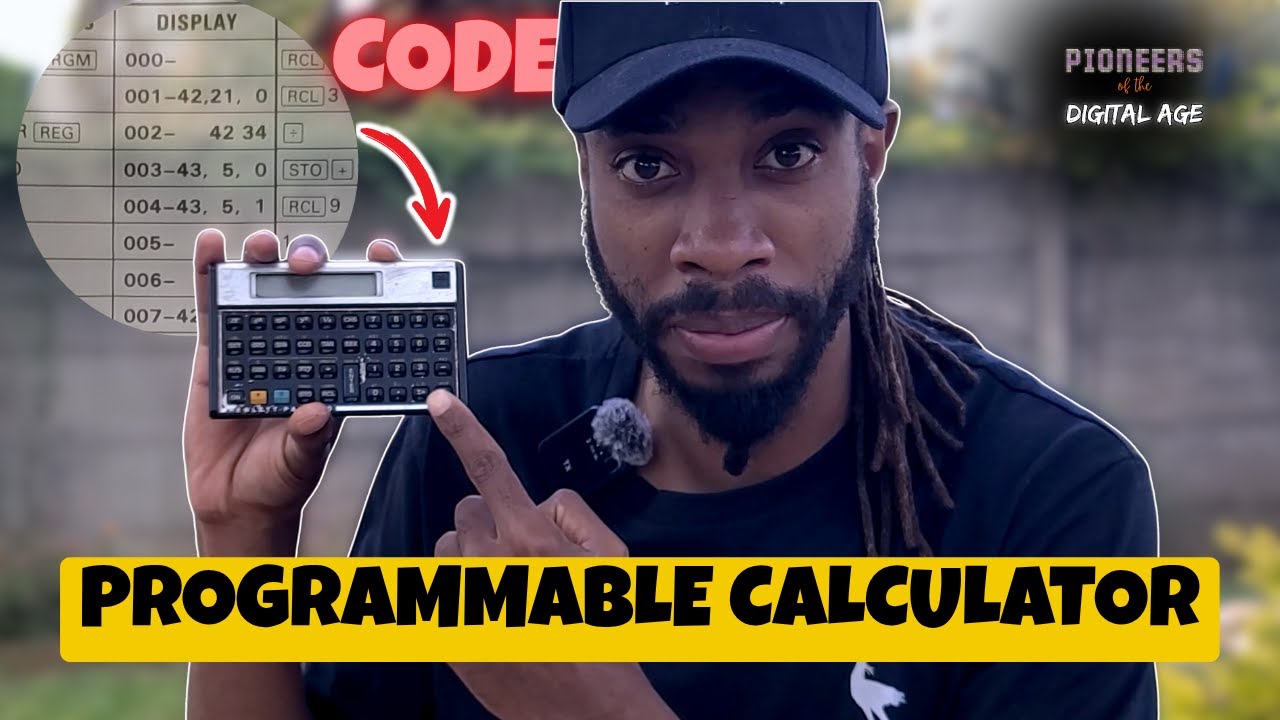
The family relic with calculator muscle
This story starts in 1981, when Hewlett-Packard released the Voyager series of calculators. A year later, in 1982, my father bought an HP-11C. Not “an HP-11C like this one.” This one.
He kept it in excellent condition, then handed it down to me in 2007. By then Zimbabwean money had already gone through one of its more theatrical eras. Fast forward to 2025 and the money has changed again, because apparently our currency enjoys a seasonal wardrobe.
The calculator, meanwhile, is still going. Quietly. Reliably. Sitting there like a tiny black-and-gold monument to a time when electronics were built less like accessories and more like tools for surviving a moon landing.
The real story is not that the HP-11C is old. The real story is that this little machine gave me my first taste of programming.
The equal key is missing, and that is the point
The HP-11C is not a normal calculator. The first clue is that it does not behave like the calculators most people grew up using.
On a regular calculator, adding 4 and 7 feels obvious. You press 4, plus, 7, equals, and the machine obediently spits out 11 like a well-trained arithmetic pigeon.
On the HP-11C, things are different. You enter the numbers, use the ENTER key, then apply the operation. That feels strange until you realise the calculator is not trying to imitate paper notation. It is using reverse Polish notation, or RPN, and the ENTER key is not an equals sign.
The ENTER key is more like a gatekeeper for the calculator’s automatic memory stack. That sounds like something a wizard would say while holding a soldering iron, so here is the plain version: the calculator stores values in a stack, and operations work on the values already waiting there.
It is unusual at first. Then it becomes oddly satisfying. There is a rhythm to it. A kind of compact mechanical grammar. You stop thinking “where is the equals key?” and start thinking “what values are on the stack?”
That is already a small programming lesson hiding inside arithmetic.
Then the calculator becomes a tiny computer
The HP-11C is not just a calculator. It is programmable. You can write little programs on it. Tiny, disciplined, keystroke-sized programs, but programs all the same.
In the video, I use a simple example: calculating the area of a circle from its radius. The formula is ordinary enough: square the radius, then multiply by pi.
On a normal calculator, that takes a handful of keystrokes every time. On the HP-11C, you can store the procedure once, then run it again whenever you have a new radius.
That is the doorway. Not because the circle example is complex. It is not. The doorway is the idea that you can teach a machine a repeatable procedure and then reuse it.
That is programming in miniature: define the steps, store the steps, feed the machine new input, and let it do the boring part without developing opinions.
Small machine, serious ideas
The simple circle-area program only scratches the surface. The HP-11C can handle more interesting logic, including conditional behaviour and loops. In modern programming terms, you can start recognising cousins of the ideas you meet later in C, JavaScript, C#, Python, and every other language people use to start arguments on the internet.
There is input. There is stored procedure. There is flow. There is memory. There is repetition. There are decisions.
Of course, the interface is brutally compact. You are not writing elegant source code on a glowing editor with autocomplete and a smug AI assistant whispering suggestions. You are pressing physical keys and thinking carefully because the machine gives you very little room for nonsense.
That constraint is part of the charm. Modern tools often hide the shape of computation. The HP-11C makes the shape visible. Every step has weight. Every stored instruction feels intentional. Every keypress has a little click of consequence.
Why I still care about this thing
Is the HP-11C still practical today? For most people, probably not. Your phone is faster. Your laptop is smarter. A spreadsheet can do more while also finding new ways to ruin your formatting.
But usefulness is not always the same thing as speed. Some machines matter because they teach you how to think.
This calculator made programming feel like a secret language. Not in the gatekeeping sense. In the discovery sense. It was the first time I felt that a machine could be given a procedure and trusted to follow it. That changed something in my head.
Before the IDEs, frameworks, databases, cloud platforms, business systems, dashboards, bugs, invoices, and deployment gremlins, there was this: a calculator, a stack, a program mode, and the realisation that logic could be stored.
The HP-11C did not teach me everything about programming. It did something more important: it made programming feel possible.
The lesson hidden in the keys
The HP-11C is a reminder that computing is not only about raw power. It is about ideas made physical. A stack is an idea. A stored procedure is an idea. A loop is an idea. A conditional branch is an idea. The device matters because it lets you touch those ideas with your fingers.
That is why retro-tech still has value. Old machines strip away the layers. They make the logic visible again.
When you use something like the HP-11C, you are not just playing with nostalgia. You are meeting computation before it put on a nice shirt, moved to the cloud, and started calling itself a platform.
Final thought
The HP-11C is not a museum piece to me. It is an origin story with batteries.
It came from my father. It survived decades of use. It outlived several versions of Zimbabwean money, which is not a small achievement. And somewhere along the way, it opened the first door into the world I now work in.
That is the quiet power of a good tool. It does not merely solve the problem in front of you. Sometimes it teaches you how problems can be solved.
And once you learn that, you are never quite the same again.