Computer History · Clueless Pundit
Coding in the 1910s: IBM vs Remington Rand
Before Apple fought Microsoft, before Google and Meta turned the internet into a corporate cage match, there was an older tech feud. It ran on punched cards, lease fees, patents, tabulators, and one wonderfully petty question: who owns the holes?
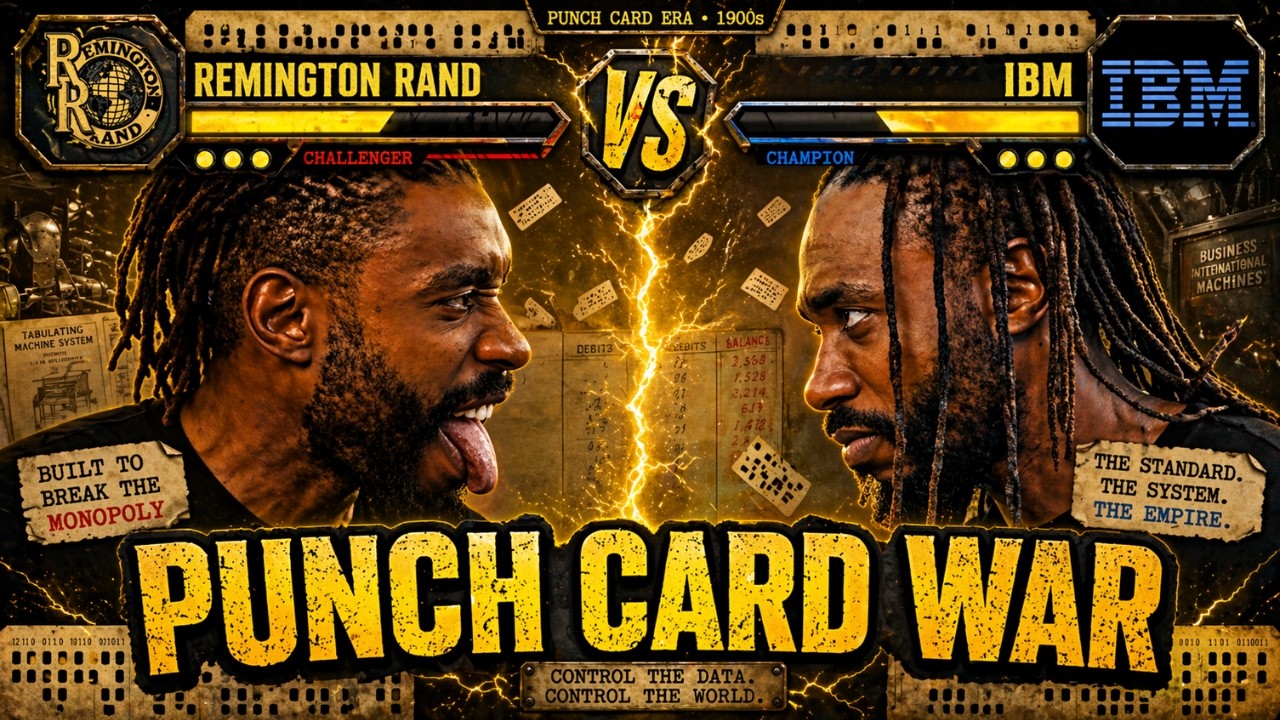
You’ve probably heard the famous tech rivalry playlist: Apple versus Microsoft, Google versus Meta, Elon Musk versus whichever institution dared to exist within tweeting distance.
Those fights feel modern because the costumes are modern. The instincts are ancient. Long before Silicon Valley learned to weaponise launch events, companies were already fighting over platforms, lock-in, patents, formats, customers, and control.
Only the platform was not a phone, a browser, or a cloud service. It was a stiff rectangle of paper with holes punched through it.
Core idea: the first computer war was not really about computers as we know them. It was about controlling the machines that processed the paperwork of modern life.
The story starts with Hollerith
To understand the IBM versus Remington Rand feud, you have to go back to Herman Hollerith and the 1890 United States Census.
Hollerith built a system that used punched cards and electromechanical tabulators to speed up census counting. Instead of drowning clerks in forms for years, the government could turn people into machine-readable records and count them at industrial speed.
That sounds dry. It was not. This was data processing before the phrase had grown a moustache and opened a LinkedIn account.
The trouble came later. Hollerith’s company controlled the machines, the cards, and the patents. When lease fees rose, the Census Bureau looked at the situation and had the usual government reaction to vendor lock-in: polite panic followed by procurement-shaped revenge.
Enter James Powers
James Powers worked inside the Census Bureau. His mission was simple: break Hollerith’s grip without technically stepping on Hollerith’s patents.
Hollerith’s machines read round holes electrically. Powers built a rival system using rectangular holes and a more mechanical reading method.
Rectangular + mechanical = legally different enough to start a corporate headache
Technically different. Practically similar. The sort of innovation lawyers describe with calm voices while everyone else reaches for the whisky.
On one side you had Hollerith’s Tabulating Machine Company, the seed that eventually grew into IBM. On the other side you had Powers Accounting Machine Company, which later moved through Remington Typewriter and Rand Kardex into Remington Rand.
Two companies. Two ecosystems. One growing civilisation suddenly desperate for machines that could count, sort, add, print, file, and remember.
Why the punched card mattered
Today a punched card looks harmless. A museum fossil. A bookmark for someone who owns too many tweed jackets.
In the early twentieth century, it was closer to a platform. Banks, insurance companies, factories, railways, and government departments were drowning in numbers. Payrolls, ledgers, inventories, risk tables, census returns, sales records: the modern office had become a paperwork swamp wearing a waistcoat.
The punched card gave that swamp a nervous system.
Once an organisation bought the machines, trained the staff, punched the cards, and built its workflow around the system, switching became painful. That pain was power. If that sounds familiar, congratulations, you have met modern software.
The twist: IBM versus Remington Rand was not just an old hardware feud. It had format wars, patents, vendor lock-in, sales machines, ecosystem control, and customers trying not to get trapped. Basically the 1930s version of “which platform owns your data?” but with more cardboard.
The office becomes a machine room
The punched-card rivalry did not happen in isolation. It belonged to a wider explosion of business machines.
Burroughs adding machines helped clerks total long columns without melting into accounting soup. The Millionaire calculator could multiply directly, making actuarial work, engineering calculations, and compound interest less hateful. Tabulators, sorters, keypunches, adding machines, and calculators formed an office arsenal.
Before computers became glowing boxes, offices became machine rooms. The future arrived as levers, counters, card feeds, paper dust, mechanical clicks, and managers discovering that productivity could be rented by the month.
This is an important point because computing did not arrive as one clean miracle. It grew from several streams: business data processing, mechanical arithmetic, automatic switching, and electronics.
Meanwhile, electricity was learning manners
While the business-machine world was fighting over cards and tabulators, another story was unfolding in telephone systems and electronics.
In 1891, Almon Strowger built an automatic telephone switch after becoming convinced that a local operator was diverting calls away from his undertaking business. That is right: part of automatic switching history begins with an undertaker automating revenge. Computer history is never boring; people just teach it badly.
Then came the vacuum tube era. John Ambrose Fleming’s diode gave current a one-way street. Lee de Forest’s triode made amplification practical. Signals could now be controlled, strengthened, and shaped in ways mechanical systems could never manage alone.
For a while, these streams ran side by side. Business machines handled records. Electronics handled signals. Then war, logistics, codebreaking, radar, and ballistics dragged them into the same room and told them to behave.
From holes in cards to bits in memory
By the 1950s, IBM and Remington Rand were no longer merely business-machine rivals. They were computer companies.
Remington Rand had UNIVAC, the machine that helped drag electronic computing into public imagination. IBM answered with machines like the IBM 701 and, more importantly, with an industrial-strength sales and service organisation that made cautious customers feel safe buying very expensive machines that looked like they required their own weather report.
The feud had changed shape. It was no longer just about punched cards. It was about memory, magnetic tape, vacuum tubes, programming, business confidence, and who could convince governments and corporations that their computer would be a tool rather than an air-conditioned monument to regret.
Grace Hopper also belongs in this world. Her work around programming and compilers points to the next layer of the story: once the machines existed, the next problem was teaching humans how to command them without sacrificing a goat to the instruction manual.
The modern echo
IBM versus Remington Rand matters because it proves that modern tech behaviour is not especially modern.
Companies still try to own ecosystems. Customers still fear lock-in. Governments still dislike dependence on one supplier. Patents still turn engineering into theatre with invoices. And being first still does not guarantee you win.
Remington Rand had UNIVAC. IBM had the machine behind the machine: sales, service, distribution, customer confidence, and corporate stamina. In tech, invention matters. The business system around the invention often matters just as much, which is annoying but historically rude enough to be true.
The lesson
- First: computing did not begin as a glowing screen. It began as a desperate attempt to count, sort, store, and process the paperwork of modern life.
- Second: punched cards were not just storage. They were an ecosystem. Once the workflow depended on the cards and machines, switching became expensive.
- Third: the first computer war was not a clean battle between genius inventors. It was patents, government frustration, clever workarounds, mergers, sales strategy, and old-fashioned corporate wrestling in a cardboard arena.
So the next time someone tells you tech rivalries began with Silicon Valley, gently escort them back to the early 1900s, hand them a punched card, and point at the holes.
The first computer war did not start online.
It started with cardboard.
Watch the episode
IBM vs Remington Rand
The full video walks through the feud from Hollerith and Powers to IBM, Remington Rand, UNIVAC, punched cards, and the moment business machines became computer companies.
About Clueless Pundit
Let’s Debug History
Clueless Pundit digs through computer history, old machines, strange inventions, forgotten rivalries, and the chain of brilliant accidents that eventually gave us modern computing. Less museum whispering. More electricity in the wallpaper.