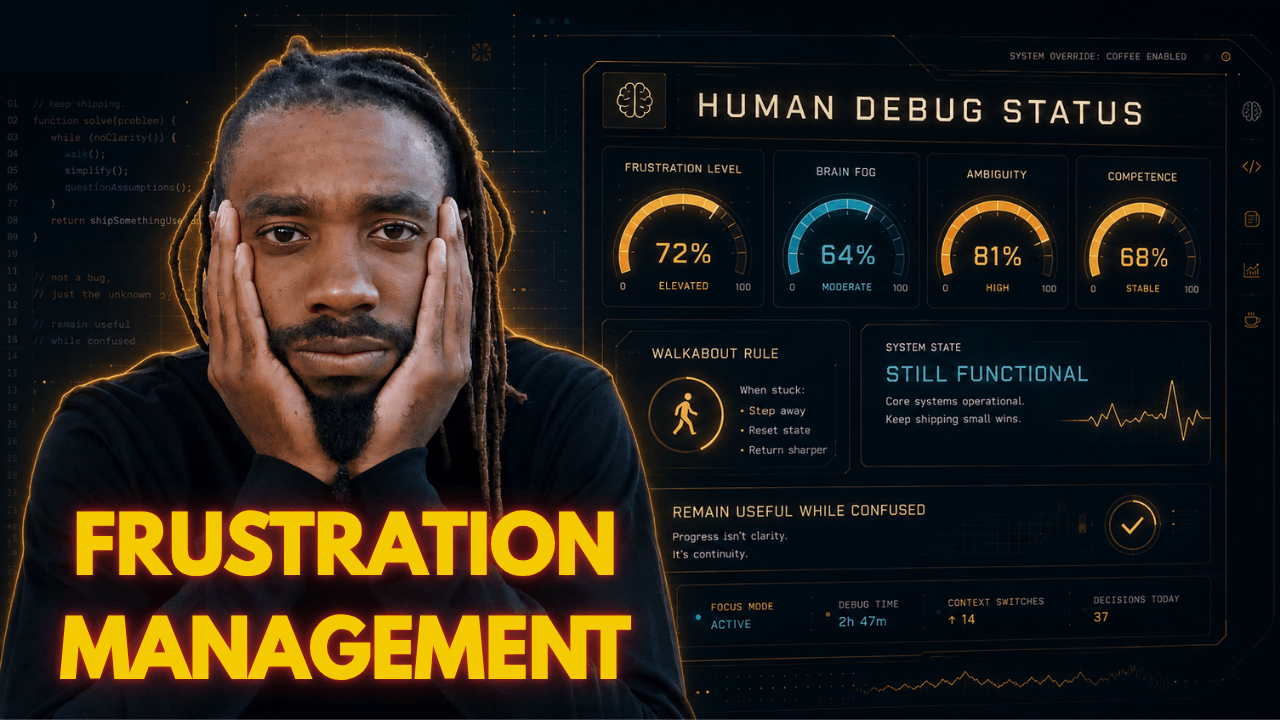
Programming is mostly frustration management
Most people assume programming is mainly an intellectual activity. They imagine a developer sitting in front of a screen, calmly arranging logic into elegant structures while the machine obediently performs acts of digital sorcery. There is some truth in that, but only in the same way that a restaurant menu is technically related to farming. It leaves out a lot of blood, sweat, confusion, and someone quietly questioning their life choices near the kitchen.
Programming requires intelligence, but intelligence is not the whole story. It requires technical skill, but technical skill is not the whole story either. After a few years of writing software, you begin to realise that a large part of the job is not simply knowing what to do. It is remaining useful when you do not know what to do. That is where many people quietly fall apart.
Programming is mostly frustration management.
That sounds dramatic until you think about what the work actually involves. You are constantly dealing with incomplete information, changing requirements, contradictory expectations, vague feedback, broken assumptions, and systems that punish your arrogance with ruthless efficiency. You may begin the morning believing you are building a feature. By lunch, you are investigating why something that worked yesterday now behaves like it was assembled in a cave by people licking the walls for sustenance.
AI Changed The Frustration, Not The Job
Artificial intelligence has reduced some of the old frustrations. It can explain syntax errors, summarise documentation, generate boilerplate, suggest fixes, and patiently answer questions that would have earned you a look of profound disappointment from a senior developer fifteen years ago. That is genuinely useful. The days of spending an entire afternoon wrestling with a missing bracket may not be completely gone, but at least the bracket now has a witness protection officer.
But AI has not removed frustration from programming. It has merely changed the shape of it.
The modern developer is less likely to be defeated by a syntax error and more likely to be worn down by ambiguity. What exactly should this feature do? Who decided this requirement? Why does the client want the report to show one thing on Monday and the opposite thing on Thursday? Why is the “small change” touching half the codebase? Why does the meeting about simplifying the system require fourteen people, three diagrams, and the emotional stamina of a man negotiating peace between two angry goats?
This is where the human side of software begins to matter.
Protect The Machine Running The Software
A programmer is not just a brain attached to a keyboard. The person writing the code has a body, a nervous system, a mood, a history, a collection of bad habits, and a deeply suspicious relationship with sleep. All of that enters the work, whether we admit it or not. A well-rested developer and an exhausted developer can look at the same bug and see completely different realities. One sees a problem to investigate. The other sees proof that their career is held together by chewing gum, prayer, and fraudulent confidence.
The bug has not changed. The operator has.
That is why looking after the body is not some decorative wellness issue sitting politely on the side of the real work. It is part of the work. The machine running the software also needs maintenance, and unfortunately that machine is made of meat, blood, anxiety, memory, and whatever nonsense we have been feeding it through our eyes all week.
Running helps some people. Walking helps others. The specific activity is less important than the interruption it creates. Sometimes the brain does not need another tab open, another AI prompt, another desperate little rummage through documentation written by someone who clearly believed punctuation was a colonial conspiracy. Sometimes the brain needs distance.
Many difficult software problems are not solved by thinking harder. They are solved by thinking differently, and thinking differently often requires the body to drag the mind out of its trench. A stubborn problem can shrink after a run. A decision can become clearer after a walk. A bug that looked like a venomous creature at midnight can look like an earthworm in the morning. Our minds are very gifted at turning earthworms into king cobras, especially when tired.
This is not romantic advice. It is practical. Frustrated programmers make poor decisions. They overcomplicate simple problems, become defensive during reviews, take shortcuts they know they will regret, and sometimes start arguing with the computer as though the machine has moral agency. The computer does not hate you. It does not love you either, which is perhaps worse, but at least it is not personal.
Competence Changes The Shape Of Frustration
Competence helps.
One of the reasons beginners experience so much frustration is that everything demands conscious attention. Nothing is automatic yet. They are learning syntax, tools, architecture, workflows, naming conventions, debugging habits, and the mysterious social rituals of software teams. A simple task becomes a maze. A tiny error becomes a philosophical event. Every unfamiliar concept feels like evidence that everyone else attended a secret training camp and forgot to send the invitation.
With time, the work becomes less chaotic. Patterns emerge. You begin to recognise the smell of certain bugs. You learn which problems require patience, which require research, which require a rethink, and which require you to stop touching the keyboard before you make the situation worse. Competence reduces friction because it gives you a map. Not a perfect map, but enough of one to stop you wandering through the forest with the confidence of a drunk tourist.
But competence has a cruel little joke hidden inside it.
It does not remove frustration. It upgrades it.
A beginner may spend three hours trying to centre a button. A more experienced developer may spend three days deciding whether a convenient shortcut will become a maintenance nightmare six months from now. The beginner is frustrated because the immediate problem is difficult. The experienced developer is frustrated because they can see the future consequences of a bad decision beginning to form in the distance, like storm clouds with a project manager’s face.
Expertise does not make everything peaceful. It makes you responsible for larger consequences. The questions become heavier. The mistakes become more expensive. The simple answer becomes less attractive because you have lived long enough to see simple answers grow teeth.
This is why confidence without competence is such a dangerous little beast. It struts into the room wearing a crown made of cardboard and starts issuing orders to reality. The useful kind of confidence is quieter. It comes from having been confused before and surviving it. It comes from knowing that not understanding something immediately is not a personal failure. It is the normal entrance fee for difficult work.
Good programmers are not calm because they always know the answer. They are calm because they have learned not to panic during the period before the answer appears.
That period matters. It is where the work happens.
Cross-Training For The Brain
Another neglected part of frustration management is learning outside your field. This may sound like the sort of advice that ends up on a soft-focus LinkedIn graphic beside a man pretending to read a book near a window, but there is a serious point hiding underneath it. Software teaches a particular way of seeing the world. That is useful, but dangerous when it becomes the only way you know how to think.
Different disciplines teach different forms of patience. Music teaches repetition. Running teaches pacing. Writing teaches clarity. History teaches context. None of these replace technical skill, but they widen the number of ways your mind can attack a problem. A developer with a narrow mind will often keep reaching for technical solutions even when the problem requires judgement, communication, restraint, or a better question.
Many software problems are not purely technical. Some are communication problems wearing a technical costume. Some are planning problems hiding behind a database schema. Some are people problems that have successfully disguised themselves as feature requests. If all you have is code, everything starts looking like something that needs another abstraction layer, which is how perfectly ordinary systems end up resembling tax legislation written by a caffeinated octopus.
Learning outside software gives you more ways to approach confusion. It also humbles you, which is useful because software has a strange way of attracting people who are very confident right up until reality asks them to show their working.
Mastery Arrives Dressed As Boredom
Then there is repetition.
This is the part nobody wants to hear about because repetition is deeply unsexy. It has no cinematic lighting. It does not make for a heroic montage unless somebody adds drums and slow motion. Yet almost everything valuable depends on it.
A guitarist practises scales until the fingers stop behaving like separate incompetent animals. A runner repeats training sessions until the body learns what the mind keeps promising. A writer edits drafts until the sentence finally stops wobbling. A programmer reads logs, writes tests, reviews code, fixes small mistakes, and gradually develops the sort of judgement that looks like instinct from the outside but is actually repetition wearing better clothes.
People admire mastery but often resent the boredom that produces it. They want fluency without drills, strength without training, clarity without revision, and competence without the long apprenticeship of looking like a village idiot in public. Unfortunately, life is not usually that generous. The boring part is not a distraction from the work. Much of the time, the boring part is the work.
This is especially hard in software because the field constantly advertises novelty. New frameworks. New languages. New tools. New architectures. New things that promise to make old frustrations disappear, before arriving with fresh frustrations packed neatly inside the box. There is nothing wrong with learning new tools, but chasing novelty can become a very sophisticated way of avoiding depth.
Repetition builds trust in yourself. Not the loud kind of trust that announces itself to the room and then trips over a cable. The quieter kind. The kind that says, “I have been here before. I do not enjoy this, but I know what to do next.” That sort of confidence is earned slowly. It cannot be downloaded, prompted, outsourced, or purchased with a subscription plan, which is deeply inconvenient in an age where everyone wants transformation delivered quicker than a hiccup.
A Small Survival Kit For Frustrated Programmers
None of this is useful if it stops at diagnosis. It is one thing to say programming is frustrating. It is another thing to have a few tools ready before the next bug drags you into a trench and starts playing bagpipes at your funeral.
So here is a small survival kit. Not a productivity system. Not a life philosophy. Just a few practical rules for moments when the work starts chewing through your patience.
The 3 PM Brain Fog: Use The Walkabout Rule
If a bug has resisted you for more than an hour and your thinking has started to feel circular, leave the screen for fifteen minutes. Not three minutes. Not a fake break where you stand up while still reading Slack messages. Fifteen proper minutes away from the machine.
Walk. Breathe. Look at something that is not glowing back at you. Let the mind stop gnawing the same bone.
This works because frustration narrows attention. Once attention narrows too much, you start inspecting the same assumptions again and again. The Walkabout Rule forces a reset. It gives the problem enough distance to stop looking like a personal insult.
Ambiguity Paralysis: Write The Stupid Version First
When the problem feels too vague, write the stupid version first.
Build the roughest, most shameful, unoptimised proof of concept you can tolerate. Hard-code something. Fake a response. Write code so ugly it should probably be taken outside and spoken to sternly. The point is not to keep it. The point is to prove movement is possible.
Ugly working code can be improved. Imaginary perfect code cannot be debugged.
This is especially useful when the fear of doing something badly has become stronger than the desire to understand the problem. Once a crude version exists, the conversation changes. You are no longer debating a ghost. You have something real to inspect, criticise, improve, and eventually civilise.
The Novelty Trap: Make The Boring Tech Stack Promise
Software developers love novelty. This is understandable. New tools are exciting. They smell like possibility. They also occasionally smell like future regret, but that part is usually hidden under the marketing page.
The Boring Tech Stack Promise is simple: for new features, use proven, deeply unsexy technologies unless the problem genuinely demands something new.
Most projects do not fail because the tech stack was too boring. They fail because the humans got clever at the wrong moment. The boring tool you understand is often more valuable than the fashionable tool you barely know, especially when someone is paying you to solve a business problem rather than perform a live reenactment of your curiosity.
Novelty has its place. But if every project becomes an excuse to learn a new framework, you are not building software. You are collecting shiny objects with a keyboard.
The Rage Spiral: Name The Problem Before Touching The Keyboard
Before changing code, write down what you think is happening.
This sounds almost insultingly simple, which is usually a clue that people will avoid doing it. Frustration loves vague enemies. The moment you give the problem a shape, it becomes less theatrical.
Write one or two sentences explaining what you expected to happen, what actually happened, what changed recently, and what assumption you may be making. This small act often exposes sloppy thinking. Sometimes you discover that you do not understand the problem well enough to fix it. That is not failure. That is progress with fewer fireworks.
The Infinite Debug Hole: Change The Level Of Attack
When you have been staring at the same failing line for too long, change the level of attack.
Stop looking only at the line. Look at the input. Look at the data. Look at the environment. Look at the recent changes. Look at the assumptions. Ask whether the problem is even where you think it is.
A bug is often like smoke. You can see where it appears, but that does not mean the fire started there. Many debugging sessions become miserable because the developer keeps punching the smoke and wondering why the room is still burning.
Changing the level of attack prevents that. It forces you to move from symptom to system.
The Code Eventually Bends
Frustration tolerance, in the end, is a competitive advantage.
Two developers can have similar intelligence, similar tools, similar opportunities, and similar access to information. The difference may be that one can remain functional while confused and the other cannot. One can sit inside uncertainty long enough for understanding to form. The other interprets discomfort as a sign to escape. One can endure the dull middle of competence-building. The other keeps starting over because starting feels better than continuing.
This is not a small difference. Difficult work always contains a section where the excitement has died, the reward has not arrived, and the only thing left is the decision to keep going. That is where many people quietly exit. Not because they are stupid. Not because they are incapable. Because they have not learned how to carry frustration without treating it as evidence that something has gone wrong.
In programming, frustration is not an interruption. It is part of the terrain.
The aim is not to become emotionless. That would be absurd, and probably require becoming a printer. The aim is to become steadier. To recognise when the body needs attention. To build enough competence that confusion becomes familiar rather than terrifying. To borrow mental models from other disciplines. To tolerate repetition without mistaking boredom for failure. To keep working without turning every obstacle into a referendum on your worth.
The developers who last are not always the cleverest people in the room. They are often the ones who learn how to remain useful while the room is on fire, the requirements are mutating, the tests are failing, and someone has just said, “This should be a quick change.”
The code eventually bends.
The more important victory is learning not to break before it does.