Project owner: Takura Nyagumbo
Release: v1.1
Date: 30 July 2026
Status: Working synthesis based on eight researched dossiers
1. Era Scope
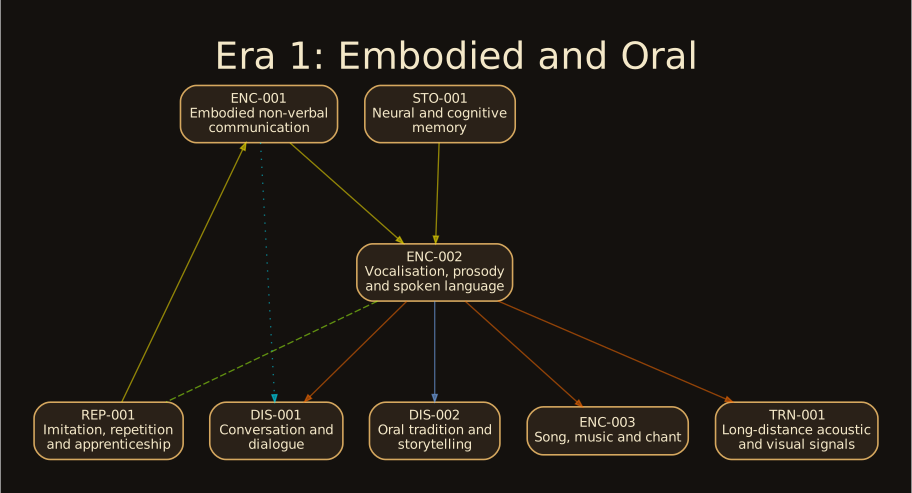
Era I covers information systems that operate primarily through living bodies, voices, memory, repetition, performance and simple distance signals.
The eight topics are:
Embodied non-verbal communicationEmbodied non-verbal communication;Vocalisation, prosody and spoken languageVocalisation, prosody and spoken language;Conversation and dialogueConversation and dialogue;Neural and cognitive memoryNeural and cognitive memory;Imitation, repetition and apprenticeshipImitation, repetition and apprenticeship;Oral tradition and storytellingOral tradition and storytelling;Song, music and chantSong, music and chant;Long-distance acoustic and visual signalsLong-distance acoustic and visual signals.
These are not preliminary scraps waiting for writing to rescue them. They remain active inside classrooms, families, workplaces, rituals, performances, telephone calls, video meetings, podcasts, interfaces and AI systems.
2. Era Thesis
Before humans built external media, they built information systems out of attention, bodies, memory, repetition and social roles.
Era I solves communication problems by coordinating living participants.
- Embodied behaviour makes attention and affect visible.
- Spoken language makes complex symbolic expression rapid and generative.
- Conversation makes meaning corrigible and jointly negotiable.
- Memory carries information through time inside organisms.
- Imitation and apprenticeship reproduce practical competence.
- Oral tradition turns individual memory into social continuity.
- Music and chant bind memory, emotion and group timing.
- long-distance signals trade semantic richness for reach.
The era is therefore not one medium. It is an interacting stack.
3. The Living Information Stack
A useful model is:
- perception: participants detect bodies, sounds and environmental events;
- attention: gaze, orientation and salience identify what matters;
- expression: gesture, voice, rhythm and action expose selected state;
- interpretation: recipients infer meaning through context and convention;
- feedback: conversation and coordinated action test whether interpretation worked;
- memory: experience alters future cognition and behaviour;
- reproduction: imitation, repetition and teaching stabilise practices;
- social custody: recognised performers, elders, teachers and specialists maintain traditions;
- relay: signals or people extend reach beyond immediate co-presence.
No layer is perfectly reliable. The system persists because layers compensate for one another.
4. Embodied Communication and Shared Attention
Embodied non-verbal communication begins with the body as the first available communication surface.
Gaze, facial movement, posture, gesture, touch, orientation and coordinated action can:
- reveal affect;
- direct attention;
- invite or repel;
- demonstrate action;
- regulate distance;
- coordinate timing;
- support silent communication.
The strength of embodied communication is its fit to the immediate moment. The weakness is the same. Meaning depends on context, co-presence and perceptual access.
Later systems repeatedly attempt to preserve or transmit bodily information through image, film, video, avatars and machine vision. None fully reproduces the reciprocal density of co-presence.
5. Spoken Language and Generative Expression
Vocalisation, prosody and spoken language combines vocalisation, prosody and spoken language.
Its central breakthrough is compositional expression. A fixed signal can warn. Spoken language can describe a past event, propose a future plan, qualify uncertainty, ask a question and revise the message when the listener looks confused.
Speech offers:
- negligible material cost;
- rapid production;
- hands-free operation;
- immediate feedback;
- emotional and pragmatic richness;
- high flexibility.
It remains transient, range-limited and dependent on shared language, hearing, attention and memory. Those limitations create pressure for conversation protocols, oral tradition, writing, recording, telephony, broadcasting and computational speech systems.
6. Conversation as a Protocol
Conversation and dialogue is not merely two people taking turns producing speech. It is an interaction protocol.
Conversation enables:
- turn-taking;
- repair;
- clarification;
- challenge;
- negotiation;
- adaptation to visible response;
- distributed reasoning;
- relationship maintenance.
The receiver can become the sender before the exchange ends. Meaning is tested and revised in real time.
This makes conversation powerful for teaching, diagnosis, planning, bargaining and conflict resolution. It also creates vulnerabilities to domination, interruption, coercion, manipulation and unequal control of the floor.
7. Memory as Transformation Through Time
Neural and cognitive memory is the first storage topic.
Memory does not preserve experience as an untouched file. It selects, encodes, consolidates, retrieves, reconstructs and forgets. Its value lies partly in transformation:
- regularities can be extracted;
- irrelevant detail can disappear;
- emotionally important events can be prioritised;
- skills can become procedural;
- past experience can guide prediction.
Its weaknesses include distortion, interference, mortality, cue dependence and weak auditability.
External records do not replace memory. They couple with it. A book still requires attention, interpretation and internal learning. Search engines reduce recall demands while increasing the importance of remembering how and where to retrieve.
8. Reproducing Competence
Imitation, repetition and apprenticeship shows that information can be transmitted as capability rather than description.
A learner observes, attempts, receives correction, repeats and gradually performs with less supervision. Apprenticeship embeds those mechanisms in a social relationship and productive environment.
This system is especially powerful for knowledge that is:
- difficult to verbalise;
- embodied;
- sequence-sensitive;
- tool-dependent;
- context-sensitive;
- risky without supervision.
Its costs are time, access to skilled practitioners, exposure to local errors and dependence on the quality of feedback.
Manuals, video and simulation later extend instruction, but demonstration and practice remain indispensable because knowing a proposition is not the same as being able to act.
9. Oral Tradition as Distributed Social Memory
Oral tradition and storytelling turns memory into an institutional and cultural system.
Stories, genealogies, laws, ritual texts, histories and practical knowledge can persist through:
- repeated performance;
- formulaic structure;
- recognised custodians;
- audience correction;
- ritual occasions;
- place cues;
- social sanctions;
- intergenerational teaching.
Oral tradition is not simply one person remembering for a long time. It distributes memory across people, roles and events.
It can adapt to new conditions, which supports survival but complicates the modern expectation of one fixed version. Authority may rest in recognised performers, lineages or organisations rather than in a stable artefact.
10. Music, Song and Chant
Song, music and chant integrates temporal pattern, emotion, memory and coordination.
Rhythm and melody can:
- stabilise recall;
- synchronise movement;
- mark group identity;
- intensify ritual;
- carry words;
- organise call-and-response;
- create affective force beyond literal propositions.
Music does not merely decorate information. It changes how messages are remembered, felt and enacted.
Its meanings may be culturally specific, and performance can exclude as well as unite. Later notation, recording and broadcasting preserve or distribute music while altering the relation between performer, audience and occasion.
11. Long-Distance Signals
Long-distance acoustic and visual signals extends selected information beyond ordinary speaking distance using drums, horns, whistles, smoke, fire, flags and visual relays.
The system gains range by reducing semantic complexity. It works best for prearranged categories such as:
- danger;
- assembly;
- arrival;
- victory;
- death;
- time;
- route status.
The receiver must know the code. Weather, terrain, noise and line of sight limit performance. Relays increase reach while adding latency and opportunities for error.
This trade between vocabulary and distance reappears in semaphore, telegraphy, signalling codes and low-bandwidth machine protocols.
12. Constraint Reductions
Era I reduces:
- privacy of attention and affect;
- inability to communicate complex plans;
- inability to repair misunderstanding immediately;
- loss of information after an event;
- inability to reproduce practical skill;
- loss of group memory across generations;
- weak emotional and temporal coordination;
- ordinary limits of speaking distance.
13. Constraints That Remain
The era does not solve:
- absence;
- exact long-term replication;
- durable audit trails;
- large-scale simultaneous distribution;
- reliable attribution;
- stable interpretation across languages and cultures;
- transmission beyond living custodians;
- cheap search across large stores.
These limitations create the pressure for external symbols and durable records.
14. Power and Organisations
Living information systems create roles:
- speaker;
- listener;
- elder;
- storyteller;
- teacher;
- apprentice;
- ritual specialist;
- messenger;
- signal keeper;
- witness.
Authority can rest in memory, eloquence, age, lineage, performance skill or control of communicative occasions.
The systems can widen participation because they do not require literacy or manufactured media. They can also centralise authority because knowledge may be restricted to recognised custodians, initiation groups, professions or political leaders.
15. Fidelity and Adaptation
Era I resists a simple fidelity scale.
Conversation can repair errors immediately but leaves a weak durable record. Oral tradition can preserve structure over generations while adapting details. Apprenticeship can reproduce effective skill without explicit explanation. Music can retain words while changing emotional interpretation. Memory can generalise usefully while losing detail.
The relevant question is not only:
Was every element copied exactly?
It is also:
Did the system preserve the information necessary for the community's purpose?
That distinction remains important in later systems. Compression, summarisation, translation and machine generation all preserve some properties while transforming others.
16. What Survives
Every Era I topic remains active.
- Bodies still regulate interaction.
- Speech remains the default high-bandwidth human interface.
- Conversation remains central to repair and trust.
- Memory integrates external information with goals and action.
- Apprenticeship remains essential to practical competence.
- Oral tradition continues in families, communities and public culture.
- Music continues to coordinate identity and emotion.
- simple signals remain useful when speed and robustness matter more than expressive range.
Later media are layered over these systems. They do not stand on empty ground.
17. Bridge to Era II
Era II begins when information is made less dependent on living presence.
Rock art anchors visual meaning to place. Tallies, tokens and notation externalise exact state. Writing allows language-bearing messages to survive without a speaker. Clay, stone, papyrus, parchment and paper create material persistence. Scroll and codex architectures organise extended records for use.
The transition is not from unreliable humans to reliable objects. It is from living reconstruction to material records with different failures:
- decay;
- loss of context;
- restricted literacy;
- custodial power;
- material scarcity;
- semantic disappearance.
18. Era Conclusion
Era I establishes the permanent human layer of the map.
Information begins as coordinated life: bodies exposing state, voices composing meaning, participants repairing understanding, memory carrying experience and communities reproducing what matters.
External media later increase persistence, reach and scale. They remain dependent on living perception, interpretation, teaching and trust. The first information systems never vanished. They became the human operating layer inside everything that followed.