Project owner: Takura Nyagumbo
Release: v0.3
Date: 29 July 2026
Status: Working synthesis based on thirteen researched dossiers
1. Era Scope
Era II follows the movement from durable but context-heavy marks to language-bearing, quantitative and institutionally usable records.
The thirteen topics are:
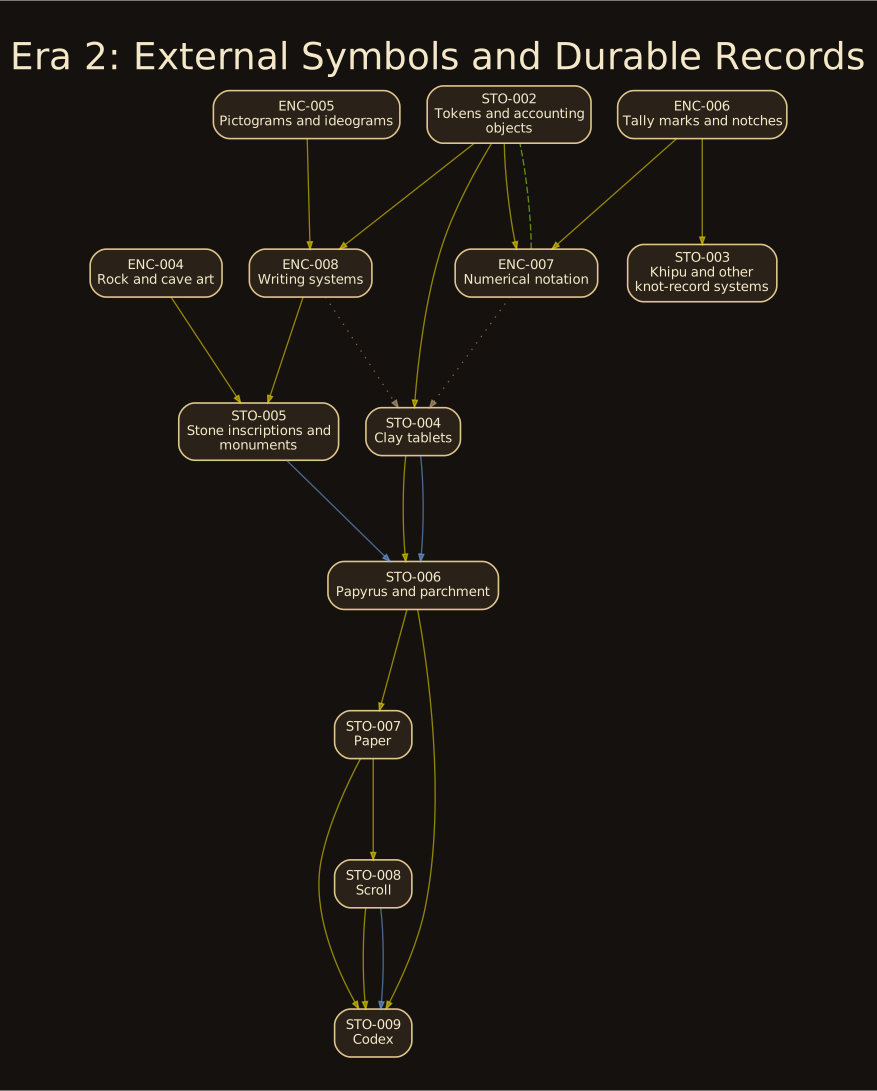
Rock and cave artRock and Cave ArtPictograms and ideogramsPictograms and IdeogramsTally marks and notchesTally Marks and NotchesTokens and accounting objectsTokens and Accounting ObjectsNumerical notationNumerical NotationKhipu and other knot-record systemsKhipu and Other Knot-Record SystemsWriting systemsWriting SystemsClay tabletsClay TabletsStone inscriptions and monumentsStone Inscriptions and MonumentsPapyrus and parchmentPapyrus and ParchmentPaperPaperScrollScrollCodexCodex
Era II is not a staircase from crude pictures to perfect books. It is a set of overlapping solutions to different information problems.
2. Era Thesis
Humans did not merely externalise memory. They learned to engineer records by separating representation, substrate, structure, location and retrieval.
A mark can preserve a quantity without preserving language. A token can represent state without using a flat surface. A writing system can survive across clay, stone, skin and paper. A scroll and a codex can carry the same words while creating different reading behaviours.
The era therefore establishes that an information object has at least five separable layers:
- Encoding: what distinctions the signs represent.
- Substrate: what physical material receives or embodies the record.
- Document architecture: how the material is arranged for handling.
- Institutional procedure: who creates, validates, stores and interprets it.
- Access interface: how a user reaches a particular piece of information.
3. Major Transitions
3.1 From scene to convention
Rock art can anchor meaning to place without operating as a complete language-representing system. Pictograms and semasiographic signs increase reuse through convention. Writing systems go further by representing language, allowing messages to outlive the speaker with greater propositional range.
3.2 From memory aid to exact state
Tallies externalise recurrence. Tokens make quantities and categories manipulable. Numerical notation compresses exact magnitude into signs that can be compared and calculated. Khipu shows that structured records need not be flat or ink-based: topology, knot type, colour and hierarchy can carry information.
3.3 From sign system to document
Writing is not identical to its material support. Clay tablets, stone inscriptions, papyrus, parchment and paper create different information behaviours even when the script remains the same.
- Clay combines writeable state, sealing and exceptional archaeological survival.
- Stone binds selected claims to place, scale and public authority.
- Papyrus and parchment make extended writing portable.
- Paper makes the sheet increasingly cheap, standardisable and reproducible.
3.4 From stored text to navigable text
The scroll and codex reveal that storage capacity is not enough.
A scroll presents a controlled sequential window. A codex makes leaves directly reachable and allows bookmarks, page references, comparison and indexing. The codex therefore represents an access-interface innovation, not merely a new container.
4. Constraints Reduced
Era II reduces:
- dependence on individual memory;
- dependence on speaker presence;
- uncertainty about exact quantity;
- inability to preserve long messages;
- bulk and weight of earlier record systems;
- difficulty moving information between organisations;
- difficulty locating passages inside long documents.
The reductions are uneven. Stone improves persistence while worsening portability. Paper lowers cost while some industrial chemistries reduce longevity. The codex improves addressability while binding can fix or naturalise a textual order.
5. New Trade-offs and Dependencies
External records create new dependencies:
- specialised literacy and numeracy;
- knowledge of codes, scripts and units;
- access to raw materials and trained labour;
- archives, libraries and custodians;
- authentication and provenance;
- environmental control;
- retrieval systems for growing collections;
- political control over what is recorded and preserved.
The era therefore shifts information vulnerability. A spoken message depends on living memory. A manuscript depends on material supply, institutional custody and semantic continuity.
6. Power and Selection
Externalisation does not make memory neutral.
Authorities choose which victories are carved. Administrators choose which quantities enter accounts. Scribes choose textual forms. Libraries choose what to preserve. Later archaeologists and museums choose what receives attention.
Durability can magnify selection. Stone and fired clay survive well, so official and administrative voices may dominate reconstructions. Organic media vanish in wet climates, making some societies look less documented than they were.
The central warning is:
The surviving archive is not the past. It is the residue produced by material properties, organisations, accidents and power.
7. Structural Decisions Produced by Era II
Era II forced the project to add or formalise:
- physical versus semantic persistence;
- material and procedural affordances;
- manipulability and topology;
- auditability and tamper evidence;
- substrate versus document architecture;
- addressability and access pattern;
- emplacement and effective publicness;
- production ecology;
- conservation environment;
- unit portability versus corpus portability.
These dimensions will be tested again when archives, libraries, copying systems and postal networks are researched in Era III.
8. Evolutionary Spine
A useful, but non-exclusive, spine through the era is:
durable image → reusable sign → tally → token → numeral → structured record → writing → documentary substrate → long-form document → addressable book
This spine should never be drawn as a universal succession. Khipu, monumental inscription, scroll and codex coexist. Rock art and oral tradition remain meaningful after writing. Paper does not erase parchment. New media layer themselves over older practices.
9. Era Conclusion
Era II is where information becomes materially engineered.
Humanity learns that meaning can be separated from the body, quantity from the counted objects, language from the speaker, and text from any one substrate. It also learns that format controls thought and action: a cliff inscription, clay tablet, scroll and codex do not merely preserve different amounts of information. They create different audiences, authorities, navigation costs and survival patterns.
The decisive step was not simply writing things down. It was learning that the design of the record determines what can be remembered, moved, trusted and found.