Date: 29 July 2026
Coverage: 11 researched topics
1. Era Thesis
Era III is the period in the map where information becomes an institutional object. Records are authenticated, selected, stored, described, copied, routed, multiplied and sold through durable roles and procedures. A message no longer depends only on whether one speaker remembers it or one artefact survives. It enters systems designed to preserve authority, context, location, lineage and audience.
The era’s central movement is:
from individual documents and carriers toward coordinated information organisations and reproducible publics.
2. The Eleven-Topic System
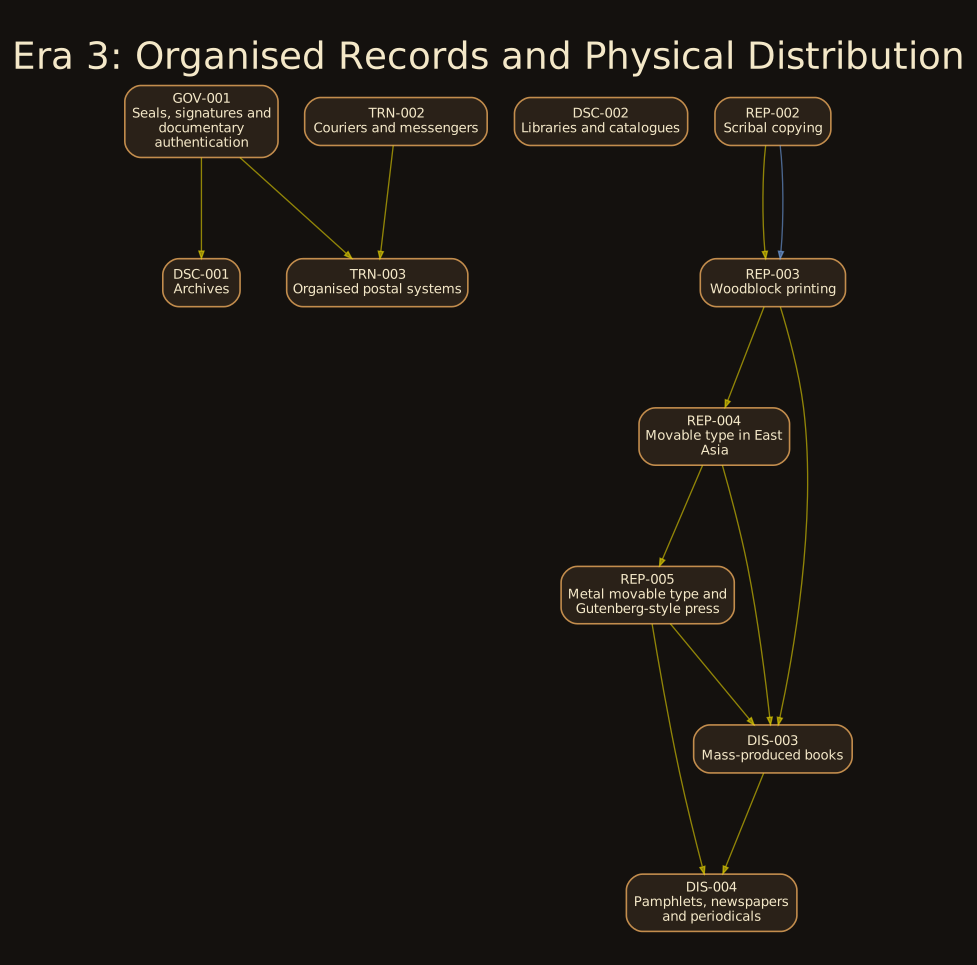
Seals, signatures and documentary authentication binds documents to identity, authority, consent and custody through seals, signatures and authentication procedures.
Archives preserves records with provenance and context, while also exposing the power of appraisal, destruction and archival silence.
Libraries and catalogues makes accumulated works discoverable through catalogues, classifications and descriptive surrogates.
Scribal copying renews texts through scribal lineages, creating redundancy and variation.
Couriers and messengers uses human messengers as integrated transport, custody and interpretation agents.
Organised postal systems decomposes delivery into routes, relays, sorting, addressing and service rules.
Woodblock printing stores pages as reusable woodblock matrices.
Movable type in East Asia stores reusable characters and turns page composition into an inventory-and-retrieval problem.
Metal movable type and Gutenberg-style press integrates European typefounding, presswork, ink, finance and workshop organisation.
Mass-produced books turns copies into editions, titles, markets and distributed reading populations.
Pamphlets, newspapers and periodicals turns publication into a recurring service organised by cadence and topicality.
3. Trust Before Scale
Mass reproduction is valuable only when readers can decide what a document is, who issued it and whether it has changed. Seals and signatures supply visible trust cues, but the research notes rejects the idea that one mark proves everything. Identity, authority, consent, integrity and custody are separate claims.
As information systems scale, trust becomes procedural. Registries, witnesses, controlled materials, title pages, printers’ devices, postal custody and archival provenance surround the message. The document is no longer self-explanatory. Its evidential force depends on the system that produced and preserved it.
4. Memory as Selection
Archives and libraries externalise institutional memory, but they do not preserve everything. Records are never created uniformly. Appraisal retains some and destroys others. Catalogues describe holdings through categories that can reveal or hide.
Era III therefore replaces the naive storage question, “Does the object survive?” with harder questions:
- Was the record created?
- Was it selected?
- Did its context survive?
- Can it be found?
- Is access permitted?
- Can later readers interpret its description?
Institutional memory includes silence as well as content.
5. Copying Creates Lineages
Scribal copying demonstrates that reproduction can preserve and transform simultaneously. A copied text becomes a new witness capable of surviving its exemplar, but it can also introduce omission, harmonisation, commentary or censorship.
Printing changes the economics and regularity of this lineage without abolishing variation. Page blocks, movable type and press formes multiply shared settings, yet wear, correction, paper and finishing still produce states. Exact identity remains an aspiration rather than a universal property.
6. Delivery Becomes a Network
A courier carries knowledge and judgement in one body. A postal system separates that task into standard routes, relays, sorting points and destination identifiers. This transition introduces network concepts that will dominate later eras: topics, links, handoffs, addressing, routing, service levels and metadata exposure.
The postal system also demonstrates that transport reach and user access differ. A state can maintain an excellent dispatch network that ordinary people cannot use. Infrastructure can be extensive and still politically closed.
7. Reproduction Becomes Economic
Mechanical reproduction moves cost toward setup and capital. Woodblocks embody one page. Movable type embodies a sign inventory. European typographic shops integrate many components into a repeatable production system.
As marginal copies become cheaper, publishers confront run size and demand. The edition appears as a planned population of objects. This creates distributed access and preservation, but also unsold inventory, censorship chokepoints and pressure to choose works likely to recover costs.
8. Publics Become Recurring
Mass-produced books allow dispersed readers to share bounded works. Pamphlets intervene quickly. Newspapers and periodicals create open-ended serial publics. Readers return not only for one text but for a stream.
Cadence synchronises attention. It also creates a permanent deadline and a commercial appetite for novelty. By the era’s end, information organisations are no longer merely preserving the past. They are manufacturing a shared present.
9. Era-Wide Constraints Reduced
Era III reduces:
- uncertainty about documentary authority;
- loss of institutional context;
- difficulty locating accumulated works;
- dependence on one manuscript copy;
- ad hoc long-distance delivery;
- renewed inscription labour per copy;
- cost of revising and recombining printed text;
- scarcity of substantially shared extended works;
- latency of recurring public updates.
It does not yet solve communication speed. Even the finest edition and postal network remains tied to physical movement.
10. Era-Wide Trade-Offs
The era introduces:
- administrative surveillance;
- archival exclusion and silence;
- metadata bias;
- textual normalisation;
- postal interception;
- capital-intensive publishing;
- standardised error;
- inventory risk;
- censorship of visible workshops;
- recurring attention pressure;
- information abundance without guaranteed discovery.
11. Transition to Era IV
Era III builds the institutional skeleton later networks inherit. Authentication becomes cryptographic trust. Archives become digital repositories. Catalogues become search indexes. Postal routes become telegraph and data networks. Type inventories become character encodings and fonts. Periodical cadence becomes broadcasting schedules and feeds.
Era IV begins when transmission speed finally detaches from the movement of a physical document. The administrative machine is ready. Electricity gives it nerves.
12. Era Verdict
Era III turned information into an institutional supply chain: authenticated at origin, preserved in context, described for retrieval, copied into lineages, routed through networks, manufactured as editions and renewed through serial attention.