1. Era Thesis
Era IV changes the relationship between information, distance, event and audience.
Electricity separates signal speed from physical transport, recording separates sensory traces from the event, and broadcasting separates mass reception from individual delivery.
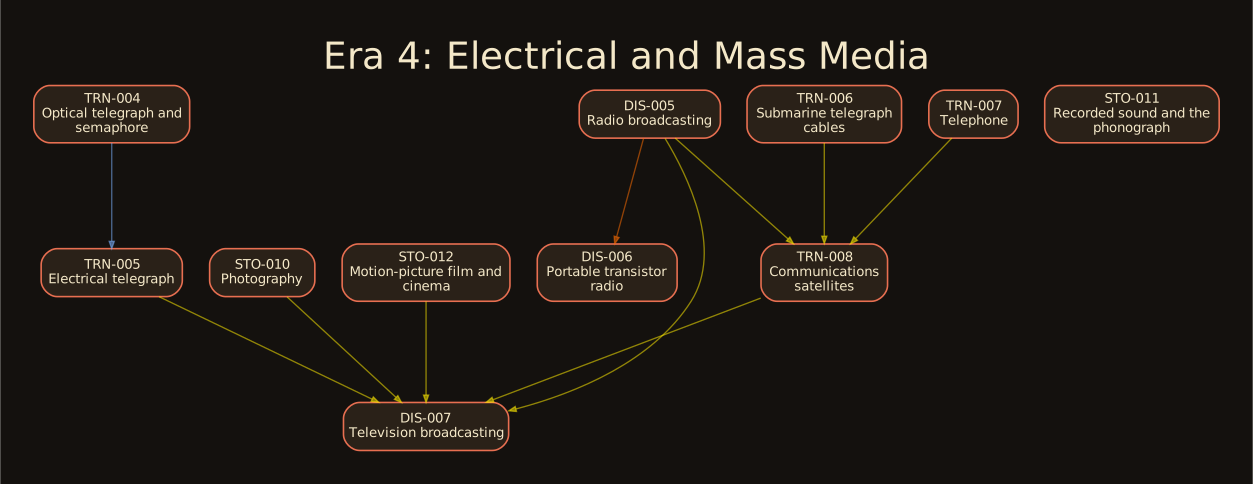
The era contains eleven topics:
Optical telegraph and semaphoreOptical Telegraph and SemaphoreElectrical telegraphElectrical TelegraphSubmarine telegraph cablesSubmarine Telegraph CablesTelephoneTelephonePhotographyPhotographyRecorded sound and the phonographRecorded Sound and the PhonographMotion-picture film and cinemaMotion-Picture Film and CinemaRadio broadcastingRadio BroadcastingPortable transistor radioPortable Transistor RadioTelevision broadcastingTelevision BroadcastingCommunications satellitesCommunications Satellites
Together they create the modern expectation that messages can outrun vehicles, voices can be heard without speakers being present, events can leave mechanical traces and entire populations can receive the same programme at once.
2. First Transformation: Faster Than Transport
Optical telegraph networks show that messages can be relayed faster than a horse by converting them into visible code. Their speed still depends on daylight, weather, terrain and staffed stations.
Electrical telegraphy detaches the signal from visibility. Coded pulses travel through wires, and service organisations manage encoding, offices, tariffs and delivery. Submarine cables extend this network across oceans, turning distant markets and governments into near-real-time participants while concentrating power at routes and landing stations.
The telephone then changes message structure. Telegraphy sends bounded text through operators. Telephony establishes a synchronous voice session between subscribers. Immediate feedback improves negotiation and social presence but occupies network capacity and participant attention over time.
3. Second Transformation: The Event Leaves a Trace
Photography stores selected effects of light. Sound recording stores selected pressure variation. Film stores ordered visual samples that can be replayed as movement.
These systems do not preserve events whole. They create traces through apparatus. Framing, sensitivity, exposure, bandwidth, frame rate and operator decisions determine what enters the record. Carrier survival, copying and playback then determine what later audiences can recover.
Recorded media create new forms of evidence and memory. They also create new possibilities for staging, retouching, editing, ownership and reuse without consent. A trace can be causally connected to an event while remaining incomplete or misleading.
4. Third Transformation: One Stream, Many Receivers
Radio broadcasting reorganises wireless transmission into a scheduled public service. The transmitter does not address individual listeners. It radiates one stream into a footprint.
The transistor receiver changes access at the edge. Radio becomes mobile, battery-powered and personally controlled. The medium can accompany work and travel or enter private listening spaces.
Television adds moving images and strong visual attention. It increases production cost and framing power while creating shared domestic spectacle. Communications satellites then extend contribution and distribution beyond terrestrial horizons, making global live events technically routine while adding orbital and gateway dependencies.
5. Three Distinct Kinds of Separation
Era IV can be understood through three separations:
5.1 Signal from carrier transport
Telegraph and telephone signals move without moving a physical letter along the whole route.
5.2 Representation from original event
Photographs, records and films persist after the people and moments they captured have disappeared.
5.3 Reception from individual delivery
Broadcast audiences receive a common stream without a separate path or copy being created for each user.
These separations are cumulative. Television can broadcast recorded film through satellite links. The era's systems converge into layered infrastructures.
6. New Organisations
Era IV expands the importance of:
- telegraph companies and international cable consortia;
- telephone exchanges and subscriber networks;
- studios, laboratories and record manufacturers;
- cinemas and programme distributors;
- radio and television broadcasters;
- spectrum regulators and standards bodies;
- audience-measurement firms;
- satellite operators, earth stations and international coordination agencies.
The machines are inseparable from these organisations. A telephone without switching has narrow reach. A film without exhibition remains inaccessible. A transmitter without programmes is an empty channel. A satellite without earth stations is an expensive object practising solitude.
7. Time Architectures
The era creates several distinct relations to time:
- telegram: delayed message with rapid long-distance transport;
- telephone: synchronous session;
- photograph: persistent visual instant or interval;
- sound recording: replayable acoustic duration;
- film: replayable sampled movement;
- radio and television: scheduled programme flow;
- satellite: continuous or windowed relay depending on orbit.
“Faster” is therefore insufficient as a comparison. Systems organise latency, duration, replay, simultaneity and availability differently.
8. Fidelity Architecture
Era IV requires a layered concept of fidelity:
- Encoding fidelity: How accurately is information converted into signals or traces?
- Channel fidelity: What distortion occurs during transmission?
- Carrier fidelity: What survives on the physical record?
- Copy fidelity: What changes between generations?
- Playback fidelity: How accurately is the stored or received representation reconstructed?
- Context fidelity: Does the audience retain knowledge of source, framing, date and purpose?
A clear broadcast signal can carry propaganda perfectly. A sharp photograph can omit the decisive action outside the frame. Technical fidelity and truthful interpretation must remain separate.
9. Geography and Infrastructure
Electricity compresses distance unevenly. Cables follow routes. Exchanges cluster in cities. transmitters create coverage gradients. Satellites create footprints but depend on gateways and terminals.
The era therefore replaces travel time with infrastructure geography. Access depends on proximity to lines, coverage, receiver ownership, electricity, prices and permission. Remote regions may gain dramatic access through radio or satellites while remaining excluded from high-capacity interactive service.
10. Attention and Power
Telegraphy concentrates control in offices and operators. Telephony creates more direct interaction but depends on exchanges. Recorded media allow absent people to be replayed without renewed participation. Broadcasting creates scarce public channels controlled by organisations.
Television adds visual persuasion and turns audience attention into measurable commercial inventory. The transistor receiver gives users more mobility and privacy but does not grant them transmitter access. Satellites expand footprints while concentrating launch and orbital resources.
Across the era, user convenience often grows alongside infrastructural centralisation.
11. Persistence and Ephemerality
Electrical signals are fast but often fleeting. Telegrams may leave paper records, while telephone calls historically vanish unless recorded. Radio and television programmes can reach millions and still disappear if no archive captures them.
Recorded media are persistent but fragile. Chemical decay, format obsolescence and missing playback apparatus can silence surviving carriers. Preservation increasingly requires migration, metadata and institutional intervention.
The era therefore severs reach from survival. A message may be globally influential and leave almost no recoverable trace.
12. Major Civilisational Contributions
- Near-real-time coordination across regions and oceans.
- Synchronous long-distance conversation.
- Visual and acoustic evidence beyond written description.
- New arts of photography, recorded music and cinema.
- Shared national and global events.
- Emergency warnings and public education at mass scale.
- International news and market integration.
- Portable personal media.
- Global telephone and television distribution.
- Technical standards and international spectrum governance.
13. Major Harms and Trade-Offs
- Infrastructure monopolies and unequal access.
- Colonial and geopolitical control of cables and spectrum.
- Surveillance of communication networks.
- Consent violations in recording and representation.
- Propaganda and centralised agenda setting.
- Attention capture and advertising pressure.
- Visual manipulation and false evidential certainty.
- Cultural homogenisation and minority-language exclusion.
- Format obsolescence and archival loss.
- Military dependence and dual use.
- Orbital congestion and debris.
14. Evolutionary Bridges to Era V
Era IV creates several prerequisites for programmable and networked information:
- electrical and electronic signalling;
- switching and addressing;
- coded discrete states;
- high-volume administrative communication;
- signal amplification and regeneration;
- recorded media as machine-readable inputs;
- audience metrics and information markets;
- global relay infrastructures;
- standards for interoperability.
Era V will transform these signals and records into digital states that machines can process, store and route programmatically.
15. Visual Model
A useful era graphic should show three crossing axes:
- distance: courier speed to electrical and orbital transmission;
- time: live event to persistent recording and replay;
- audience: addressed endpoint to mass broadcast footprint.
The eleven topics can be placed where they alter one or more axes. Telephone sits near synchronous addressed interaction. Photography sits near persistent trace. Radio sits near mass simultaneous reception. Television and satellites combine all three axes most visibly.
16. Final perspective
Era IV does not merely make communication faster. It creates new relationships between presence and absence.
A distant person can speak in real time. A dead performer can sing again. A past scene can move on a screen. Millions can hear one voice simultaneously. A satellite can relay that voice beyond the horizon.
These capabilities produce a recurring illusion that mediation has disappeared. It has not. Operators, apparatus, standards, schedules, cameras, studios, transmitters and regulators remain between event and audience. They become less visible precisely as the experience becomes more immediate.
The era's deepest lesson is therefore double. Information can escape the speed of transport, the mortality of performance and the limits of local audiences. But every escape route becomes new infrastructure, and every infrastructure creates new owners, bottlenecks and forms of power.