Explore the topics in this era

Programmable and Networked Information

Programmable machines and networks made information computable, addressable, searchable and globally linkable.

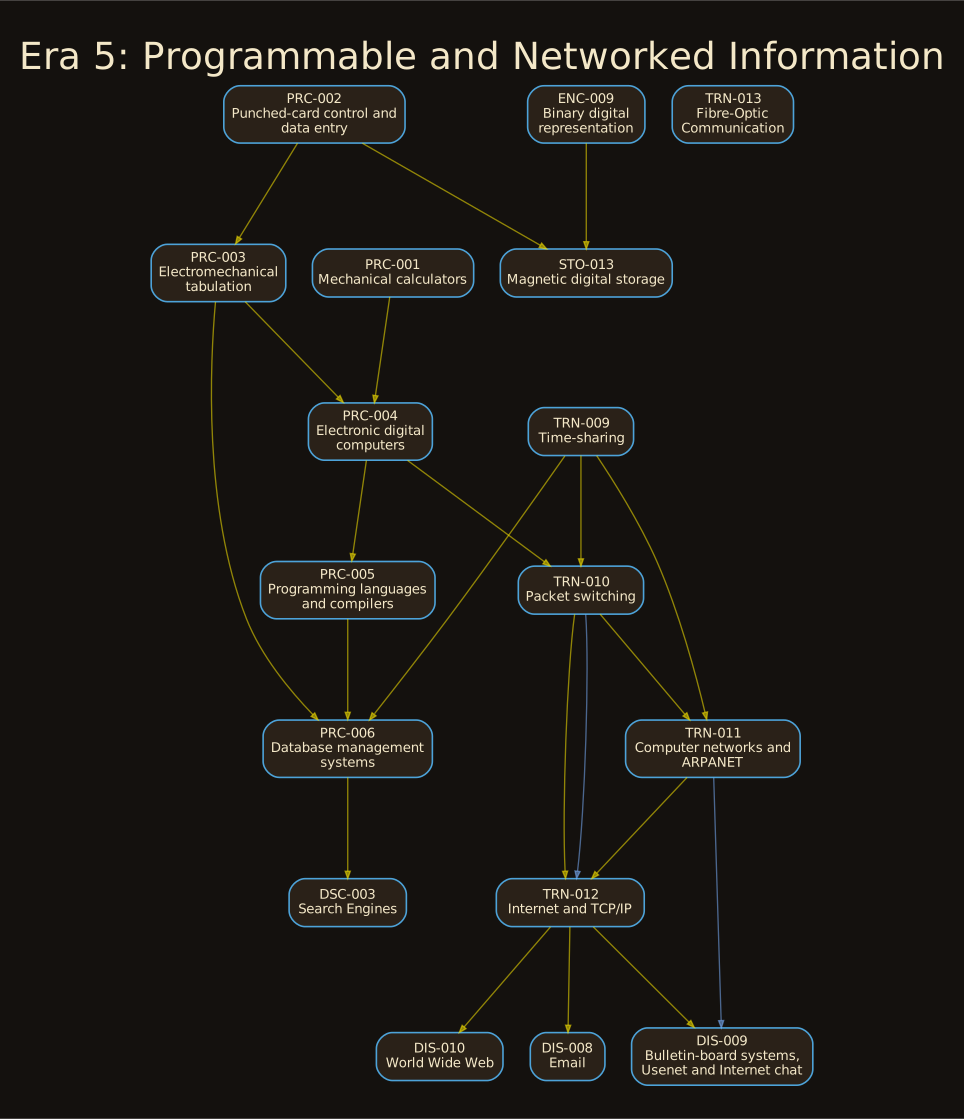
Relationship map for Era 5: Programmable and Networked Information
Era synthesis

What changed in this period?

Date: 30 July 2026
Status: Era complete, 17 of 17 registered topics researched

1. Era Thesis

Era V transforms information from a record primarily handled by people into a machine-operable object. Symbols become machine states; procedures become programs; storage becomes addressable digital persistence; processors and links become shared; networks interconnect; communication becomes online; resources become globally linkable; discovery becomes algorithmic.

The era's defining achievement is not the computer alone. It is the layered system that lets machines represent, process, preserve, transmit, link and retrieve information across institutional boundaries.

2. Completed Topics

  • Mechanical calculators Mechanical Calculators
  • Punched-card control and data entry Punched-Card Control and Data Entry
  • Electromechanical tabulation Electromechanical Tabulation
  • Binary digital representation Binary Digital Representation
  • Electronic digital computers Electronic Digital Computers
  • Programming languages and compilers Programming Languages and Compilers
  • Magnetic digital storage Magnetic Digital Storage
  • Database management systems Database Management Systems
  • Time-sharing Time-Sharing
  • Packet switching Packet Switching
  • Computer networks and ARPANET Computer Networks and ARPANET
  • Internet and TCP/IP Internet and TCP/IP
  • Email Email
  • Bulletin-board systems, Usenet and Internet chat Bulletin-Board Systems, Usenet and Internet Chat
  • World Wide Web World Wide Web
  • Search Engines Search Engines
  • Fibre-Optic Communication Fibre-Optic Communication

3. Main Progression

3.1 Procedure becomes external and executable

Calculators, cards and tabulators separate operations from the person performing them. Electronic computers and programming languages make procedures reusable, conditional and increasingly abstract.

3.2 Representation becomes layered

Binary states do not remove meaning. They create a physical-symbolic foundation above which character sets, instructions, files, schemas and interfaces accumulate.

3.3 State becomes persistent and managed

Magnetic media preserve machine-readable state. Database systems organise logical records, queries, transactions and recovery above physical storage.

3.4 Expensive machines become shared services

Time-sharing turns one computer into an interactive multi-user environment. Accounts, scheduling, quotas, protection and response time become communication concerns.

3.5 Links become statistically shared

Packet switching divides traffic into units that can share network capacity. Queueing, congestion, loss and reliability become explicit system properties.

3.6 Networks become internetworks

ARPANET demonstrates operational host networking. TCP/IP allows heterogeneous networks to interconnect without surrendering their internal designs.

3.7 Infrastructure becomes social space

Email, BBSs, Usenet and IRC turn network access into persistent and synchronous human communication.

3.8 Documents become a global information graph

The Web joins identifiers, interactions, representations and hyperlinks into a shared publishing space.

3.9 Discovery becomes algorithmic governance

Search engines crawl, index and rank a changing corpus. The problem shifts from access to selection.

3.10 Physical capacity scales through light

Fibre-optic systems make global traffic volumes practical and reveal that digital systems remain dependent on capital-intensive material infrastructure.

4. Era-Level Distinctions

  • representation versus meaning;
  • physical state versus logical data;
  • program source versus executable target;
  • storage capacity versus access latency;
  • database consistency versus external truth;
  • scheduling versus interactive service;
  • packetisation versus switching and routing;
  • network versus internetwork;
  • address versus name, route and identity;
  • protocol openness versus infrastructure concentration;
  • technical delivery versus human receipt;
  • local hosting versus federation and live relay;
  • resource versus representation;
  • publication versus discovery;
  • crawl, index, retrieval and ranking;
  • bandwidth, throughput and latency;
  • logical redundancy versus physical route diversity.

5. The New Bottleneck

At the beginning of the era, computation and storage are scarce. By the end, information can be copied, transmitted and published at extraordinary scale. Scarcity migrates toward:

  • trustworthy interpretation;
  • attention;
  • ranking and discovery;
  • identity and authentication;
  • governance;
  • security;
  • preservation of dynamic systems;
  • equitable physical access.

Era VI begins when network access becomes personal, mobile and continuous, and when platforms automate social distribution at population scale.

6. Era Verdict

Era V turns information into an executable, addressable and networked substrate. It ends not when information becomes universally available, but when abundance makes discovery, attention and governance the dominant constraints.

Topic directory

17 systems in Era 5

Mechanical calculators

Mechanical calculators

Mechanical calculators externalised parts of arithmetic into reliable physical mechanisms. A user entered numbers, selected an operation, supplied energy through a crank, key or stylus, and read a result whose intermediate carries and place-value transformations had been handled by gears, stepped drums, pinwheels or other mechanisms.

Explore topic →
Punched-card control and data entry

Punched-card control and data entry

Punched media convert the presence or absence of holes into machine-readable distinctions. The same broad material principle served at least three different functions: controlling a sequence of operations, storing a program, and representing records for repeated processing.

Explore topic →
Electromechanical tabulation

Electromechanical tabulation

Electromechanical tabulation turned collections of machine-readable records into sortable, countable and cross-classifiable administrative information. It did not begin as general computation.

Explore topic →
Binary digital representation

Binary digital representation

Binary digital representation reduces information to patterns over two distinguishable symbols or states. Those states may be written as 0 and 1, holes and no holes, high and low voltage, magnetised orientations, optical pits or other physical contrasts.

Explore topic →
Electronic digital computers

Electronic digital computers

Electronic digital computers transform discrete representations through high-speed electronic switching. Their historical significance does not fit inside one invention date or one champion machine.

Explore topic →
Programming languages and compilers

Programming languages and compilers

Programming languages make machine procedures expressible in forms designed for human composition, review and reuse. Compilers and related translators convert those source representations into target instructions or intermediate forms that a particular machine can execute.

Explore topic →
Magnetic digital storage

Magnetic digital storage

Magnetic digital storage represents machine-readable information through controlled magnetic states. Its history is not one device but a family of storage architectures: rotating drums, magnetic tape, magnetic-core memory, rigid disks, removable disk packs, floppy disks and later high-density hard drives.

Explore topic →
Database management systems

Database management systems

A database management system is not a large file and not a disk drive. It is a software and institutional system that defines persistent data structures, mediates queries and updates, coordinates multiple users, enforces rules, records changes and attempts recovery after failure.

Explore topic →
Time-sharing

Time-sharing

Time-sharing turns one scarce computer into an interactive service for many users. It rapidly interleaves processor attention, memory, storage and input/output among concurrent sessions so that each person can work through a terminal with tolerable response delay.

Explore topic →
Packet switching

Packet switching

Packet switching transmits digital traffic by dividing information into bounded units that carry control information and share network links with packets from other communications. Intermediate topics receive, store briefly, inspect and forward these units.

Explore topic →
Computer networks and ARPANET

Computer networks and ARPANET

A computer network links independently operating computers so that processes and users can exchange data or use remote resources. ARPANET was a particular publicly funded research network that separated host computers from a packet-switching communications subnet built from Interface Message Processors (IMPs).

Explore topic →
Internet and TCP/IP

Internet and TCP/IP

The Internet is an operational federation of networks that communicate through the Internet Protocol and related standards. TCP/IP is the protocol suite that made heterogeneous internetworking practical: IP carries datagrams across network boundaries, while transport protocols such as TCP provide end-to-end services above IP.

Explore topic →
Email

Email

Email is an asynchronous digital messaging ecosystem in which a sender creates a structured message, specifies one or more recipients, submits it to a transfer system and relies on intermediate or destination systems to store and deliver it to mailboxes. Message format, transport envelope, transfer protocol, mailbox storage, address resolution and user.

Explore topic →
Bulletin-board systems, Usenet and Internet chat

Bulletin-board systems, Usenet and Internet chat

This topic groups three related but distinct pre-Web community forms. A dial-up bulletin-board system usually centres on one host operated by a system operator and reached through telephone modems.

Explore topic →
World Wide Web

World Wide Web

The World Wide Web is an open distributed hypermedia system built above the Internet. Its foundational architecture combines globally usable identifiers, a request-response interaction protocol, typed representations and links embedded in representations.

Explore topic →
Search Engines

Search Engines

A search engine is an automated discovery system that acquires information about a corpus, constructs one or more indexes, interprets a query, retrieves candidate items and orders or filters results. On the Web, this usually requires crawling, parsing, duplicate handling, indexing, ranking, snippet generation and continuous refresh.

Explore topic →
Fibre-Optic Communication

Fibre-Optic Communication

Fibre-optic communication transmits information by modulating light guided through a dielectric fibre whose core and cladding create controlled propagation. The medium, transmitter, receiver, connectors, amplifiers, multiplexers and network engineering together form the system.

Explore topic →
Chronology

Era milestones

Programmable-engine concepts, 1830s onward

Babbage applies punched control and data concepts to the Analytical Engine.

Punched-card control and data entry · practical implementation

How Punched-card control and data entry emerged

This marks the broad emergence and development of Punched-card control and data entry. Why it mattered: Externalises repeatable instructions and structured records in a portable machine-readable form.

How Electromechanical tabulation emerged

This marks the broad emergence and development of Electromechanical tabulation. Why it mattered: Automates sorting, counting and summarising large structured record collections.

Electromechanical tabulation · broad emergence

Hollerith census system, 1880s-1890s

Punched cards and electrical counters demonstrate large-scale unit-record tabulation.

Electromechanical tabulation · practical implementation

Administrative unit records, 1880s-1910s

Hollerith cards represent census cases and then spread into business tabulation.

Punched-card control and data entry · practical implementation

Hollerith 1890 census system

Census attributes were punched into cards and processed through electrical counting and sorting equipment. The case demonstrates how card design, categories and machinery formed one administrative system.

Punched-card control and data entry · practical implementation

Hollerith and the 1890 United States census

Hollerith developed a system using punched cards, electrical sensing and counters. The Census Bureau adopted it for the 1890 census. The system is often credited with accelerating tabulation, although total census completion involved many stages beyond the machines.

Electromechanical tabulation · practical implementation

United States census

Hollerith equipment was adopted to process census records through punched cards and electrical counting. The case demonstrates that the machine was embedded in enumeration, coding and publication rather than operating alone.

Electromechanical tabulation · practical implementation

Commercial unit-record expansion, 1890s-1920s

Tabulation spreads to other censuses and business administration.

Electromechanical tabulation · commercial introduction

Standardised machine rooms, 1920s-1940s

Sorters, tabulators, verifiers and control panels form integrated data-processing departments.

Electromechanical tabulation · practical implementation

Standardised card ecosystems, 1920s-1950s

IBM and competitors support keypunches, verifiers, sorters, tabulators and standard card formats.

How Binary digital representation emerged

This marks the broad emergence and development of Binary digital representation. Why it mattered: Provides a robust common discrete representation for machine storage, processing and transmission.

Switching logic, 1930s

Boolean algebra becomes a practical design method for relay circuits.

Binary digital representation · practical implementation

Machine implementation, 1930s-1940s

Electromechanical and electronic computers use discrete representations, including binary.

Binary digital representation · practical implementation

Electromechanical programmability, 1930s-early 1940s

Relay systems demonstrate automatic digital procedure without electronic speed.

Electronic digital computers · practical implementation

Drum concepts and prototypes, 1930s-1940s

Rotating magnetic surfaces become plausible computer storage.

Magnetic digital storage · practical implementation

Advanced accounting machines, 1930s-1950s

Printing, multiplication and more elaborate control increase business capability.

Electromechanical tabulation · practical implementation

How Programming languages and compilers emerged

This marks the broad emergence and development of Programming languages and compilers. Why it mattered: Reduces the burden of expressing procedures directly in machine-specific instructions.

Special-purpose electronic systems, early 1940s

Colossus and related systems use electronic switching for restricted tasks.

Electronic digital computers · practical implementation

General-purpose externally programmed systems, mid-1940s

ENIAC demonstrates broad electronic numerical processing with physical reconfiguration.

Electronic digital computers · practical implementation

Early operational drums and tapes, late 1940s-early 1950s

Magnetic storage enters stored-program and commercial computer systems.

Magnetic digital storage · commercial introduction

Batch-centred computing, 1940s-1950s

Machine use is mediated through queues, operators and delayed output.

Time-sharing · practical implementation

Coexistence with early computers, 1940s-1960s

Cards and tabulators prepare data, handle reports and surround electronic processors.

Electromechanical tabulation · practical implementation

How Electronic digital computers emerged

This marks the broad emergence and development of Electronic digital computers. Why it mattered: Executes long, changeable sequences of information transformations at electronic speed.

Electronic digital computers · broad emergence

Stored-program demonstrations, 1948

Manchester Baby proves electronic stored-program operation.

Electronic digital computers · practical implementation

Practical stored-program service, 1949 onward

EDSAC and other machines support regular users and reusable programs.

Electronic digital computers · practical implementation

How Magnetic digital storage emerged

This marks the broad emergence and development of Magnetic digital storage. Why it mattered: Stores large rewritable machine-readable collections across sequential, direct-access and working-memory layers.

Magnetic digital storage · broad emergence

How Time-sharing emerged

This marks the broad emergence and development of Time-sharing. Why it mattered: Replaces long batch turnaround and exclusive machine access with concurrent interactive sessions on a shared computer service.

Time-sharing · broad emergence

Automatic programming experiments, early 1950s

A-0 and algebraic systems automate routine selection and translation.

Programming languages and compilers · practical implementation

Production high-level compilers, mid-1950s

FORTRAN demonstrates practical high-level programming with efficient generated code.

Programming languages and compilers · practical implementation

Core memory and commercial disk, mid-1950s

Fast primary memory and direct-access secondary storage mature.

Magnetic digital storage · commercial introduction

Commercial electronic data processing, 1950s-1960s

Computers enter government, science and business through vendor-supported systems.

Electronic digital computers · commercial introduction

Business and standard languages, late 1950s-1960s

COBOL and other languages expand domains and institutional portability.

Experimental interactive sharing, late 1950s-early 1960s

Proposals and demonstrations test rapid allocation among users.

Time-sharing · practical implementation

Computer program and data decks, 1950s-1970s

Cards become a dominant batch interface to electronic computers.

Punched-card control and data entry · practical implementation

How Database management systems emerged

This marks the broad emergence and development of Database management systems. Why it mattered: Coordinates shared persistent data through logical schemas, queries, controlled updates and recovery without requiring every application to manage physical storage directly.

Database management systems · broad emergence

How Packet switching emerged

This marks the broad emergence and development of Packet switching. Why it mattered: Shares network links efficiently among bursty digital traffic through packetisation, buffering and forwarding without requiring a dedicated end-to-end circuit.

Packet switching · broad emergence

How Computer networks and ARPANET emerged

This marks the broad emergence and development of Computer networks and ARPANET. Why it mattered: Connects remote computers and users to shared programs, files and communication services through host protocols over a packet-switching subnet.

How Email emerged

This marks the broad emergence and development of Email. Why it mattered: Provides asynchronous addressed message delivery across users, hosts and networks without requiring simultaneous presence or physical transport.

Email · broad emergence

Local time-sharing mail, mid-1960s

Users exchange stored messages on one shared computer.

Email · practical implementation

Standard character encoding, 1960s

ASCII and related codes improve text interchange.

Early production DBMS, early 1960s

IDS integrates reusable data-management services above direct-access storage.

Database management systems · practical implementation

Computer-utility ambition, mid-1960s

Project MAC and Multics treat shared computation as a persistent general service.

Time-sharing · practical implementation

Independent packet concepts, early-mid 1960s

Baran and Davies formulate related packetised network ideas for different institutional problems.

Packet switching · practical implementation

Experimental implementation, late 1960s

NPL and ARPANET projects turn packet switching into operational systems.

Packet switching · practical implementation

Conceptual resource sharing, early 1960s

Researchers imagine geographically distributed access to expensive computing resources.

Computer networks and ARPANET · conceptual proposal

Feasibility and material challenge, 1960s

Research identifies impurity reduction and waveguide design as the path to low-loss communication.

Fibre-Optic Communication · practical implementation

Hierarchical and network systems, 1960s-1970s

IMS and CODASYL approaches organise operational data through navigational relationships.

Database management systems · practical implementation

Removable packs and standard tape ecosystems, 1960s-1970s

Organisations build libraries, workflows and interchange practices around magnetic media.

Magnetic digital storage · standardisation

Commercial time-sharing, late 1960s-1970s

Service bureaux sell access through terminals and telecommunications.

Time-sharing · commercial introduction

Network-specific protocols, late 1960s-early 1970s

Packet networks operate with local assumptions and limited interconnection.

Internet and TCP/IP · practical implementation

Solid-state and integrated systems, 1960s-1980s

Transistors and integrated circuits improve reliability, cost and scale.

Electronic digital computers · practical implementation

Digital media expansion, 1960s-1990s

Sampling and coding bring sound, images and video into digital systems.

Binary digital representation · practical implementation

Operational academic systems, 1961-1964

CTSS, PDP-1 systems and DTSS establish practical communities.

Time-sharing · practical implementation

Kao and Hockham 1966

Establishes the waveguide, loss, mode and capacity analysis that made communications fibre scientifically credible.

Fibre-Optic Communication · practical implementation

Network design, 1966-1969

Topology, IMP procurement, host interfaces and protocols are planned.

Computer networks and ARPANET · practical implementation

Initial operation, 1969-1971

The first IMPs and hosts connect; basic host communication and remote use become operational.

Computer networks and ARPANET · earliest evidence

Relational theory, 1970 onward

Logical relations and value-based operations challenge pointer-oriented access.

Database management systems · practical implementation

Practical low-loss fibre, 1970-1977

Glass, sources and detectors cross thresholds for operational systems.

Fibre-Optic Communication · practical implementation

How Fibre-Optic Communication emerged

This marks the broad emergence and development of Fibre-Optic Communication. Why it mattered: Carries high-rate signals over long distances with low attenuation and extensive wavelength multiplexing compared with electrical conductors.

Fibre-Optic Communication · broad emergence

Format and protocol standardisation, 1970s

Headers, mailbox behaviour and transfer conventions converge.

Email · standardisation

Relational prototypes and SQL, 1970s

System R and related projects demonstrate practical declarative query processing.

Database management systems · practical implementation

Public and research packet networks, 1970s

X.25, CYCLADES, packet radio and other systems explore service models.

Packet switching · practical implementation

Protocol reassessment, mid-1970s

ARPANET limitations and heterogeneous packet networks drive internetworking research.

Computer networks and ARPANET · practical implementation

Experimental TCP, mid-late 1970s

Implementations test gateways, datagrams and end-to-end control.

Internet and TCP/IP · practical implementation

Internetworking, late 1970s-1980s

Datagram networks are connected through common protocols.

Packet switching · practical implementation

Commercial terrestrial deployment, late 1970s-1980s

Telephone carriers replace copper and coaxial trunks on selected routes.

Fibre-Optic Communication · commercial introduction

Floppy and personal-computer storage, 1970s-1990s

Removable magnetic files become personal and portable.

Magnetic digital storage · practical implementation

Networked multi-user systems, 1970s-1990s

Time-sharing hosts connect through computer networks and support remote communities.

Time-sharing · practical implementation

ARPANET network mail, 1971-1973

Messages cross hosts and user@host addressing spreads.

Email · practical implementation

Application expansion, 1971-1975

Email, remote login, file transfer and collaborative tools increase network value.

Computer networks and ARPANET · practical implementation

How Internet and TCP/IP emerged

This marks the broad emergence and development of Internet and TCP/IP. Why it mattered: Interconnects heterogeneous packet networks without requiring them to share one internal switching technology, administration or service model.

Internet and TCP/IP · broad emergence

Internetwork architecture, 1973-1974

Cerf and Kahn define network intercommunication principles.

Internet and TCP/IP · practical implementation

Cerf-Kahn 1974 internetwork protocol

This case demonstrates a distinct architectural, operational or social feature of internet and tcp/ip.

Internet and TCP/IP · practical implementation

IP/TCP separation, 1978-1981

Internet and transport functions become distinct specifications.

Internet and TCP/IP · practical implementation

How Bulletin-board systems, Usenet and Internet chat emerged

This marks the broad emergence and development of Bulletin-board systems, Usenet and Internet chat. Why it mattered: Creates shared many-to-many communication spaces in which participants can post persistent messages or converse synchronously before mainstream Web and social platforms.

Operational transition, 1980-1983

Hosts implement TCP/IP and migrate from NCP through planned coordination.

Computer networks and ARPANET · practical implementation

Internet mail architecture, 1980s

SMTP, RFC 822 formats and domain naming become foundational.

Email · standardisation

High-density hard disks and automated tape libraries, 1980s onward

Capacity, automation and network access expand dramatically.

Magnetic digital storage · practical implementation

Single-mode and submarine expansion, 1980s

Long-haul systems and transoceanic cables establish optical backbones.

Fibre-Optic Communication · practical implementation

Organisational and public adoption, 1980s-1990s

Email becomes central to institutional and personal communication.

Email · practical implementation

Commercial relational expansion, 1980s-1990s

Relational DBMS become standard enterprise infrastructure.

Database management systems · standardisation

Academic and commercial expansion, 1980s-1990s

More networks and service providers join.

Internet and TCP/IP · commercial introduction

How World Wide Web emerged

This marks the broad emergence and development of World Wide Web. Why it mattered: Makes independently hosted information globally addressable, linkable, retrievable and publishable through interoperable clients and servers.

World Wide Web · broad emergence

The 1989 information-management proposal

Shows that the Web began as an organisational memory and linking problem, not as a plan for online shopping.

World Wide Web · conceptual proposal

Proposal and prototype, 1989-1990

Core concepts are specified and first client, editor, server and site are implemented.

World Wide Web · conceptual proposal

The 1990 project proposal

Defines a practical client-server hypertext system integrating existing services.

World Wide Web · conceptual proposal

Internet resource discovery, 1990-1993

Archie and related tools index filenames and service metadata.

Search Engines · practical implementation

Standards and commercial publishing, mid-1990s

HTTP, HTML, URI and browser behaviour stabilise enough for large-scale publishing and commerce.

World Wide Web · commercial introduction

Link-analysis competition, late 1990s

PageRank and anchor-text methods improve ordering in uncontrolled hypertext.

Search Engines · practical implementation

Unicode and network interoperability, 1990s onward

Global character representation and standard formats support multilingual computing.

Commercial Internet expansion, 1990s

Packet switching becomes the ordinary substrate of global digital communication.

Packet switching · commercial introduction

Amplified WDM networks, 1990s

Optical amplifiers and multiple wavelengths multiply capacity.

Fibre-Optic Communication · practical implementation

Webmail and mass consumer service, 1990s-2000s

Browser access and free providers expand reach.

Email · practical implementation

Dynamic Web, late 1990s-2000s

Databases, scripts, sessions and user-generated content make the Web interactive.

World Wide Web · practical implementation

Web and mass public adoption, 1990s-2000s

Internet infrastructure becomes a general publishing and commerce platform.

Internet and TCP/IP · practical implementation

Public research Web, 1991-1993

Line-mode access, external servers and community adoption expand the system.

World Wide Web · practical implementation

How Search Engines emerged

This marks the broad emergence and development of Search Engines. Why it mattered: Makes large, changing and weakly organised networked corpora searchable without requiring users to know exact locations in advance.

Search Engines · broad emergence

Early Web crawling, 1993-1995

Robots, directories and full-text experiments map the linked Web.

Search Engines · practical implementation

Open release and browser competition, 1993-1996

Unrestricted software release and graphical browsers accelerate public use.

World Wide Web · practical implementation

Large public engines, 1995-1998

AltaVista, Lycos and others scale crawling, indexing and query service.

Search Engines · practical implementation

Commercial consolidation, 2000s

Search becomes advertising-supported infrastructure and a major gateway to the Web.

Search Engines · commercial introduction

Broadband and Internet backbone, 2000s

Fibre penetrates metro, access and data-centre networks.

Fibre-Optic Communication · practical implementation

Platform, cloud and mobile Web, 2000s-2010s

Global platforms and infrastructure providers dominate major flows while independent sites persist.

World Wide Web · practical implementation

Coherent high-order modulation, 2010s onward

Digital signal processing and advanced modulation extract more capacity from deployed fibre.

Fibre-Optic Communication · practical implementation

How Mechanical calculators emerged

This marks the broad emergence and development of Mechanical calculators. Why it mattered: Reduces the mental and written burden of executing repetitive arithmetic procedures.
Mechanical calculators · broad emergence

RFC 196 mailbox protocol

This case demonstrates a distinct architectural, operational or social feature of email.

Email · standardisation

RFC 733 message format

This case demonstrates a distinct architectural, operational or social feature of email.

Email · standardisation

IBM 650

The IBM 650 illustrates the centrality of drum timing and address placement in early programming practice.

Magnetic digital storage · practical implementation

IBM 305 RAMAC and 350 disk unit

RAMAC established commercial direct-access disk storage and changed the expected relationship between a computer and business records.

Magnetic digital storage · commercial introduction

RFC 675 Transmission Control Program

This case demonstrates a distinct architectural, operational or social feature of internet and tcp/ip.

Internet and TCP/IP · standardisation