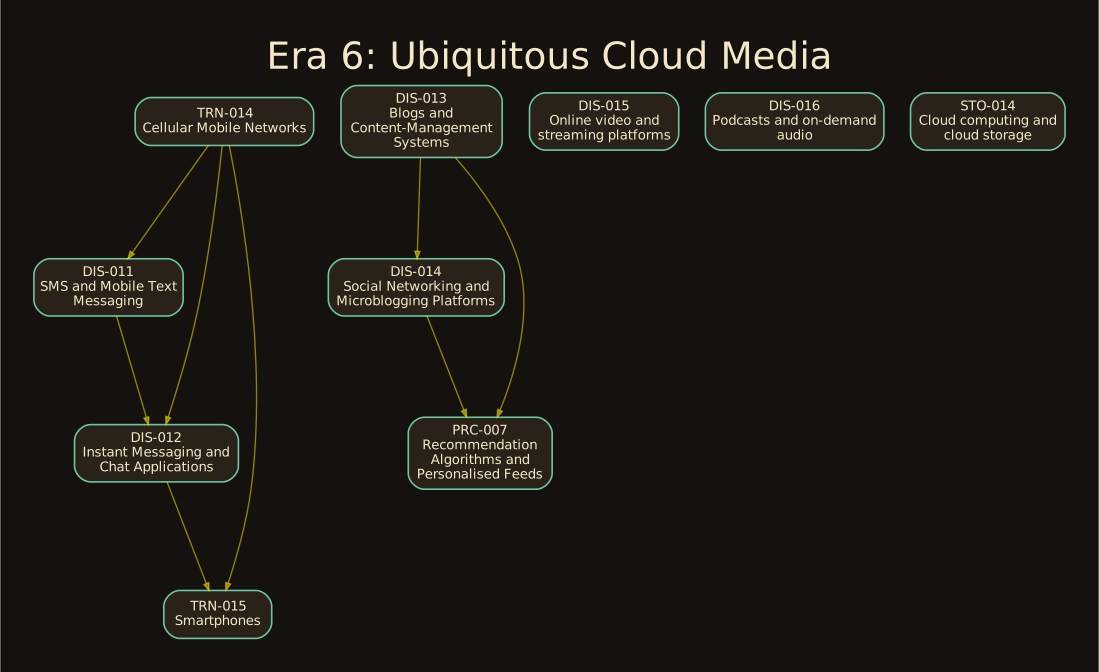
1. Era Thesis
Era VI transforms network access from an activity performed at selected terminals into a continuous personal environment.
The era contains:
Cellular Mobile NetworksCellular Mobile NetworksSMS and Mobile Text MessagingSMS and Mobile Text MessagingInstant Messaging and Chat ApplicationsInstant Messaging and Chat ApplicationsBlogs and Content-Management SystemsBlogs and Content-Management SystemsSocial Networking and Microblogging PlatformsSocial Networking and Microblogging PlatformsRecommendation Algorithms and Personalised FeedsRecommendation Algorithms and Personalised FeedsSmartphonesSmartphonesCloud computing and cloud storageCloud Computing and Cloud StorageOnline video and streaming platformsOnline Video and Streaming PlatformsPodcasts and on-demand audioPodcasts and On-Demand Audio
Together they produce this progression:
Moving reachability → addressed personal messaging → synchronised conversation → managed publication → networked audiences → personalised selection → portable convergence → remote elastic state → on-demand video → subscribed audio
Era V connected computers and made networked information publishable and searchable. Era VI attaches those systems to personal identities, carried devices, social relationships, behavioural signals and cloud services. Information no longer waits mainly at a destination. It follows the person, requests attention and adapts to inferred context.
2. The Era’s Defining Transition
The central change is from network access to continuous mediated presence.
Earlier systems ask:
- Where is the terminal?
- Which number or address should receive the message?
- Which page or server contains the information?
Era VI increasingly asks:
- Which person, account and device are reachable now?
- Which contacts, groups and social edges should receive this item?
- Which content should this recipient see next?
- Which device state should persist across disconnection?
- Which service may interrupt the person?
The network becomes not only a carrier but a manager of identity, presence, audience and attention.
3. Ten Topics, Five System Layers
3.1 Mobility layer
Cellular networks manage attachment, paging, handover and roaming so that a moving subscriber remains reachable.
3.2 Personal communication layer
SMS adds compact store-and-forward delivery. Instant messaging expands this into accounts, presence, receipts, groups, histories and multiple devices.
3.3 Publishing and social-distribution layer
Blogs and CMSs make repeated Web publication operationally cheap. Social platforms turn profiles and relationships into machine-readable distribution routes.
3.4 Selection and attention layer
Recommendation pipelines choose candidates, score them and create different ordered environments for different recipients.
3.5 Device and cloud-media layer
Smartphones combine capture, computation and identity at the edge. Cloud systems provide remote state and elastic processing. Video and podcast platforms make audiovisual media available on demand.
These layers should be drawn as interacting systems rather than a single chronological ladder. Smartphones depend on cellular networks and clouds; recommendation acts inside social and video platforms; podcasts depend on CMS and feed architecture; messaging systems use mobile identity and notifications.
4. Reachability Creates State
A fixed broadcast receiver can remain anonymous and passive. A continuously reachable personal service must maintain state.
Era VI introduces or intensifies:
- subscriber registration;
- temporary network location;
- account identity;
- device binding;
- contact lists;
- presence;
- message history;
- group membership;
- notification tokens;
- social graph edges;
- behavioural profiles;
- subscriptions;
- cloud replicas;
- playback state.
Convenience and surveillance emerge from the same coordination machinery. A system cannot route a message to a moving account, synchronise it across devices or recommend contextually without maintaining some model of identity and state.
The analytical task is not to declare state collection automatically good or bad. It is to identify which state is necessary, who observes it, how long it survives, how accurately it represents a person and which powers it enables.
5. The Personal Endpoint Becomes an Institutional Chokepoint
The smartphone is physically personal but institutionally shared.
A single handset depends on:
- manufacturer hardware and firmware;
- operating-system policies;
- carrier access;
- app-store approval;
- push-notification infrastructure;
- cloud identity and backup;
- mapping and location services;
- application providers;
- advertising and analytics systems.
This creates a new paradox:
The most personal communication device in history is also one of the most institutionally mediated.
The device owner controls possession and immediate interaction. Other organisations control updates, network attachment, application availability, remote state and parts of authentication. Personalisation should therefore never be mistaken for personal sovereignty.
6. Publishing Becomes Easy; Audience Access Becomes Conditional
Blogs and CMSs reduce the work of publication. Social platforms reduce the work of finding connected audiences. Recommendation reduces the work of choosing from abundance.
Each reduction introduces a new gate:
- CMS software and hosting determine whether the origin survives.
- Social-platform policy determines whether the account and post remain eligible.
- Recommendation determines practical visibility.
- Device notifications determine whether an item interrupts the recipient.
- Human attention determines whether the item enters cognition.
Era VI therefore separates publication freedom from distribution power. Millions can publish; comparatively few organisations control the surfaces on which large audiences encounter that publication.
7. The Audience Is No Longer One Thing
The era requires a full audience-state ladder:
- potential public;
- policy-eligible audience;
- candidate audience;
- selected audience;
- notified or displayed audience;
- playback or reading start;
- sustained attention;
- measured engagement;
- understanding;
- effect.
Follower count, delivery receipt, impression, view, download, watch time and completion attach to different states. Treating them as interchangeable gives platforms and publishers an epistemic shortcut they have not earned.
This is especially important for recommendation. A system observes behaviour only after selecting what a person could encounter. The evidence is partly produced by the previous policy.
8. Communication Becomes Both Persistent and Interruptive
Era VI combines two tendencies that appear contradictory:
- messages, feeds and media remain available asynchronously;
- notifications and presence systems create pressure for immediate response.
SMS and messaging free senders and recipients from strict simultaneity, yet read receipts and last-seen indicators can reintroduce social synchronisation. Podcasts free audio from schedule, yet applications announce each release. Video catalogues enable time-shifting, yet live streams and premieres recreate shared present time.
The era does not replace synchronous with asynchronous communication. It allows systems to choose, blend and socially manipulate both.
9. The Cloud Becomes the Hidden Memory of Personal Life
Era VI relocates much personal and institutional persistence into remote service infrastructure.
Cloud systems store:
- messages;
- contact lists;
- photographs;
- documents;
- videos;
- podcast files;
- account credentials;
- social graphs;
- behavioural histories;
- recommendation features;
- playback state.
This supports continuity across devices and failures. It also creates dependency on account recovery, provider policy, jurisdiction and service architecture.
A device can be replaced while the person’s digital environment returns. That apparent immortality is conditional. It requires the provider, identifier, keys, payment, formats and recovery path to survive.
10. Abundance Moves Scarcity Into Selection and Trust
By the end of Era VI, the technical cost of copying and publishing many forms of media has fallen dramatically. Scarcity migrates into:
- recipient attention;
- credible identity;
- trustworthy provenance;
- ranking position;
- moderation capacity;
- creator revenue;
- network quality;
- device affordability;
- repair and update support;
- independent recovery.
The next era begins because abundance also exceeds human interpretive capacity. Machines increasingly translate, transcribe, classify, moderate, generate and answer. Era VI builds the data, platforms and cloud infrastructure on which semantic automation operates.
11. Shared Control Stack
Era VI should be visualised through separate control layers:
| Layer | Typical controllers | |---|---| | Physical device | Manufacturer, owner, repair provider | | Radio access | Carrier, spectrum regulator | | Operating system | Platform vendor | | Application distribution | App store and developer | | Identity and account | Carrier, platform, service provider | | Cloud state | Provider and tenant administrator | | Social graph | Platform and users | | Content eligibility | Policy and moderation organisations | | Ranking and recommendation | Platform objectives and models | | Notification | Application plus operating-system push service | | Measurement | Platform, host, advertiser and analytics provider | | Human interpretation | Recipient, community and culture |
No one institution controls every layer, but concentrated firms often control several at once.
12. Shared Harms and Failure Modes
12.1 Continuous surveillance
Location, contacts, messages, social edges and playback behaviour can be joined into detailed personal models.
12.2 Attention capture
Notifications and feeds convert communication services into systems for repeated interruption.
12.3 Platform exclusion
Account suspension, store removal or payment failure can cut off identity, audience and stored state.
12.4 Dependency concentration
Many services can share one cloud, identity provider, app store or carrier.
12.5 Metric substitution
Clicks, views and watch time can displace harder questions about knowledge, welfare or public value.
12.6 Context collapse
Content moves among audiences with different norms, histories and intentions.
12.7 Repair and preservation failure
Devices become unsupported; feeds break; platforms close; metadata and comments disappear.
12.8 Unequal access
Data cost, device price, language, disability and coverage continue to shape who participates.
12.9 Manipulation and gaming
Creators, advertisers and political actors learn to exploit ranking and attention signals.
12.10 Apparent personal control
Interfaces feel intimate while underlying infrastructure and rules remain opaque.
13. What Earlier Eras Still Contribute
Era VI is layered on older systems rather than detached from them:
- spoken language powers calls, podcasts and video;
- writing powers messages, metadata, captions and interfaces;
- archives inspire cloud storage and catalogues;
- postal addressing survives in accounts and message delivery;
- print periodicals survive in blogs and subscriptions;
- telegraph store-and-forward logic survives in messaging;
- telephony survives inside smartphones;
- radio survives in podcasts and live streams;
- television survives in video platforms;
- databases hold accounts, graphs and histories;
- Internet protocols connect every service;
- the Web supplies links, identifiers, feeds and publication origins.
The era’s novelty lies in convergence, personalisation and continuity, not in erasing ancestry.
14. New Analytical Instruments Produced by Era VI
The completed era adds the following reusable instruments:
- mobility-management fields;
- messaging delivery-state ladder;
- presence and attention separation;
- account-device binding fields;
- managed-publication fields;
- profile-person separation;
- social-edge routing analysis;
- audience-state ladder;
- recommendation-pipeline model;
- objective-versus-welfare distinction;
- device-service allocation map;
- cloud control-plane/data-plane split;
- durability-availability-consistency separation;
- media ingest-to-attention ladder;
- feed-host-directory-app separation;
- ownership-by-layer model;
- failure-domain independence analysis.
These instruments should be reused during Era VII because semantic systems inherit all of these dependencies while adding interpretation and generation.
15. Era Verdict
Era VI makes communication ubiquitous by binding networks to people, devices, accounts, social relationships and cloud state. It makes publishing abundant, messages persistent, audiences computable and media available on demand. It also makes the path between sender and recipient more institutionally complex.
The recipient no longer merely chooses a channel or visits a site. Platforms maintain a model of who the recipient is, where the device is, which relationships matter, what has been watched, what should appear next and when the person can be interrupted. The communication system becomes an environment.
This environment greatly expands human agency. A person can record an event, publish it globally, organise a community, access vast archives and speak to distant audiences from one carried device. Yet the same environment concentrates data, attention and operational control in platforms whose rules are often difficult to inspect or escape.
Era VI therefore ends with a paradox that prepares the next era:
Information has become easier to capture, store and distribute than to evaluate, trust and understand.
That pressure leads directly to machine translation, speech recognition, automated classification, generative models and conversational assistants.
Era VI transforms network access into continuous mediated presence. Communication follows the person, persists across devices, travels through social and algorithmic routes, and arrives as cloud-backed media on demand.