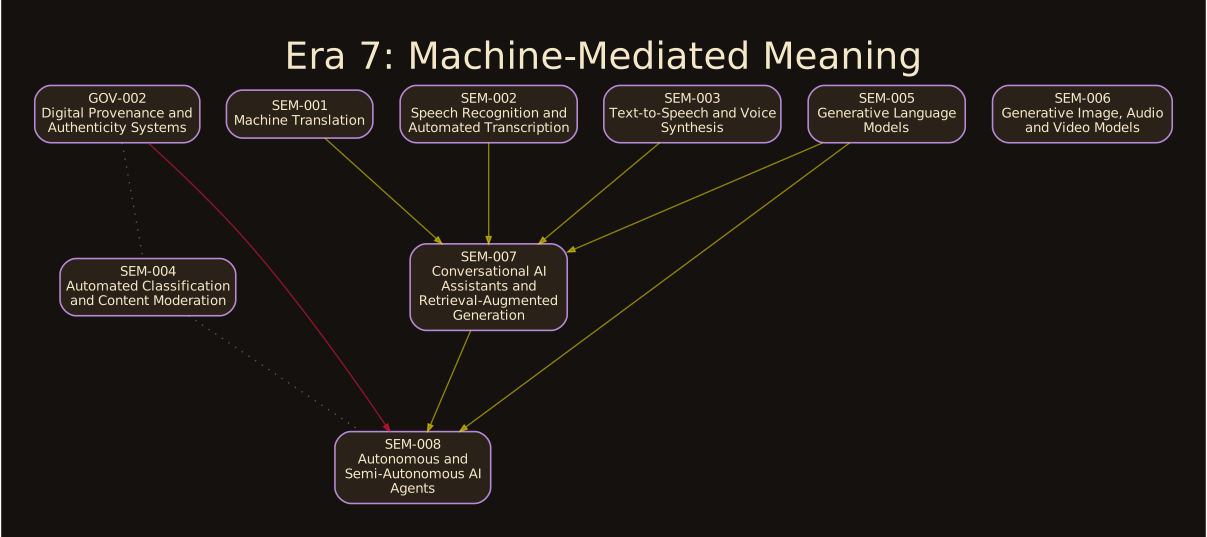
1. Era Thesis
Era VII examines systems that do not merely carry, store or retrieve information. They transform the form in which meaning is expressed, classify what information signifies for organisations, generate new communicative objects, interact through dialogue and increasingly act within the world.
The era contains:
Machine TranslationMachine TranslationSpeech Recognition and Automated TranscriptionSpeech Recognition and Automated TranscriptionText-to-Speech and Voice SynthesisText-to-Speech and Voice SynthesisAutomated Classification and Content ModerationAutomated Classification and Content ModerationGenerative Language ModelsGenerative Language ModelsGenerative Image, Audio and Video ModelsGenerative Image, Audio and Video ModelsConversational AI Assistants and Retrieval-Augmented GenerationConversational AI Assistants and Retrieval-Augmented GenerationAutonomous and Semi-Autonomous AI AgentsAutonomous and Semi-Autonomous AI AgentsDigital Provenance and Authenticity SystemsDigital Provenance and Authenticity Systems
Together they produce this progression:
Language conversion → acoustic interpretation → synthetic performance → machine classification → symbolic generation → perceptual generation → conversational synthesis → delegated action → provenance-aware trust
The era’s defining transition is from machines moving representations to machines participating in the construction, selection and operational consequence of meaning.
2. The Machine Enters the Semantic Layer
Earlier eras already contain interpretation. A human reader interprets writing. A telegraph operator encodes language. A search engine ranks documents according to an engineered model of relevance. Era VII intensifies and automates this mediation.
The machine now performs operations such as:
- selecting one translation among several plausible meanings;
- inferring words from an uncertain acoustic signal;
- generating pronunciation, rhythm and voice;
- mapping speech or media to institutional categories;
- generating new text, images, sounds and moving scenes;
- combining retrieved evidence into conversational answers;
- choosing and executing actions across tools;
- attaching signed claims about origin and transformation.
These are not neutral relays. They are transformations governed by models, datasets, objectives, thresholds, prompts, permissions and institutional policy.
3. Interpretation Is an Inference, Not a Copy
The first three topics make the asymmetry of language mediation visible.
3.1 Machine translation
Translation reconstructs meaning across linguistic systems. There is rarely one mechanically identical target sequence. Grammar, culture, register, ambiguity and purpose shape the result.
3.2 Speech recognition
Recognition infers symbolic sequences from acoustic evidence. The signal is continuous, noisy and affected by speaker, microphone, environment and language model expectations.
3.3 Text-to-speech
Big-picture essays begins with controlled symbols but must generate timing, pronunciation, stress, emotion and acoustic identity. It produces a performance, not merely an audible font.
The era therefore rejects the idea that these systems are reversible format converters. Information is reconstructed at every boundary.
4. The Language-Mediation Ladder
Era VII retains the fourteen-stage language ladder introduced in Batch 15:
- source event or expression;
- physical or symbolic capture;
- signal preparation;
- segmentation;
- recognition or parsing;
- structural interpretation;
- semantic reconstruction;
- target-language or target-form generation;
- pronunciation and prosody planning;
- acoustic synthesis or textual rendering;
- packaging and delivery;
- human perception;
- human interpretation;
- behavioural or institutional consequence.
The ladder allows error to be located precisely. A transcript may contain correct words but wrong speaker attribution. A translation may be fluent but semantically distorted. A voice may be intelligible but impersonate an unauthorised identity.
5. Classification Turns Interpretation Into Governance
Automated Classification and Content Moderation marks the point where machine interpretation becomes an institutional decision input.
The moderation chain is:
Object → representation → score → threshold → policy category → review → enforcement → notice → appeal → restoration or confirmation
The model predicts. The institution governs.
This distinction prevents a common evasion in which policy choices are disguised as technical inevitabilities. A classifier does not decide by itself that a post should be removed, an account suspended or an applicant denied. Thresholds, categories, sanctions and appeal systems are institutional design.
Accuracy therefore cannot answer every governance question. A highly accurate classifier can enforce an unjust rule. An imperfect classifier can be useful when it merely prioritises human review. Consequence must be part of evaluation.
6. Generation Produces Candidates, Not Facts
Generative language models and generative media models expand the machine’s role from interpreting existing objects to producing new ones.
6.1 Symbolic generation
A language model estimates plausible token sequences under learned patterns and supplied context. Fluency, relevance and instruction following can be strong without direct evidentiary grounding.
6.2 Perceptual generation
Image, audio and video models sample media from learned distributions conditioned by prompts, references and control signals. The output can possess the surface grammar of photography or recording without corresponding capture.
The era establishes two mandatory gaps:
- plausibility is not truth;
- realism is not authenticity.
The output becomes a communicative candidate. Evidence, attribution, authorisation and context must be supplied separately.
7. The Machine-Output Ladder
Era VII retains the twelve-stage ladder introduced in Batch 16:
- source object or corpus;
- data selection and representation;
- model processing;
- internal score, distribution or latent sample;
- thresholding, decoding or rendering;
- human-readable output;
- provenance and system metadata;
- human or institutional interpretation;
- decision, publication or action;
- receiver encounter;
- verification, appeal or correction;
- entry into future datasets and feedback.
A score becomes consequential only after thresholds and policy. A token distribution becomes prose only after decoding. A latent sample becomes an image only after rendering. The institution that uses the output remains part of the causal chain.
8. Conversational Assistants Compress the Machine Room
Conversational AI Assistants and Retrieval-Augmented Generation combines several earlier topics behind one conversational surface:
- speech recognition and synthesis;
- language models;
- search and retrieval;
- databases and private corpora;
- recommendation and reranking;
- tool APIs;
- persistent memory;
- identity and policy systems.
The result is lower interaction cost. A user can ask one question rather than navigate several applications and query languages.
The danger is epistemic compression. Retrieval, selection, disagreement, uncertainty and generation arrive as one coherent voice. A polished paragraph can hide a failed search, a stale source or a citation that supports only half the sentence.
The era therefore separates:
- retrieved from generated;
- cited from supported;
- grounded from true;
- remembered from verified;
- conversational continuity from human-like identity.
9. Agents Close the Control Loop
Autonomous and Semi-Autonomous AI Agents extends machine mediation from explanation to delegated operation.
The agent loop is:
Goal → observe → plan → permission check → act → observe consequence → verify → revise or stop
This closes the information loop. Machine-generated interpretation changes the environment from which the next observation is drawn.
The unit of analysis becomes the trajectory. A small error at one step can propagate through planning, execution and feedback. The relevant safeguards are therefore systemic:
- least privilege;
- approval gates;
- sandboxing;
- action limits;
- monitoring;
- stop controls;
- independent verification;
- rollback and incident response.
The key question is not simply “How intelligent is the agent?” It is “What authority does it possess, over which time horizon, with what observability and recovery?”
10. Provenance Becomes the Trust Counterpart
Digital Provenance and Authenticity Systems responds to the fact that digital and generated objects can separate appearance from production history.
A provenance system can record signed assertions about:
- capture device;
- creator or organisation;
- ingredients;
- editing actions;
- generation tool;
- timestamps;
- publication chain;
- file integrity.
It does not automatically prove:
- that the signer is honest;
- that the scene was not staged;
- that every prior edit is included;
- that the caption is accurate;
- that the signer had authority;
- that the represented proposition is true.
The era therefore distinguishes integrity, identity, authenticity and truth. “Verified” without an object is banned from serious analysis. Verified what, by whom, under which trust chain, against which claim?
11. Identity Fractures Across the Era
Era VII requires several identities to be separated:
- speaker identity;
- account identity;
- device identity;
- model identity;
- tool identity;
- signer identity;
- represented identity;
- authorised identity;
- accountable institution.
A generated voice can resemble a speaker without their participation. An account can use an assistant operated by another provider. An agent can act with credentials issued to a human. A provenance manifest can be signed by software on behalf of an organisation.
Identity is therefore not one field. It is a graph of claims and authority relationships.
12. Evidence Lineage Becomes Essential
As machines synthesise more of the visible output, receivers need lineage at several levels.
12.1 Data lineage
Which corpora, documents, recordings or media shaped the system?
12.2 Inference lineage
Which model, version, prompt, context, retrieval and decoding process produced the output?
12.3 Action lineage
Which goal, plan, permission, tool and approval produced an external change?
12.4 Content lineage
Which capture, generation, ingredients and edits produced the artefact?
No one lineage answers every question. Training influence may be impossible to identify at the individual source level. Private prompts may not be publishable. Security-sensitive agent traces may require restricted audit. The era requires proportional lineage rather than indiscriminate total surveillance.
13. Feedback Becomes Synthetic
Generated outputs increasingly return to future systems as training data, search results, evidence and institutional precedent.
This creates several loops:
- generated prose enters Web corpora;
- search indexes and assistants retrieve it;
- generated media trains future detection and generation models;
- moderation decisions become labels;
- agent actions alter databases used for later planning;
- signed outputs gain authority and circulate as evidence;
- user responses to machine-selected content become behavioural training signals.
The information environment can become self-referential. Machine outputs influence the data used to judge future machine outputs.
The map must therefore record source generations, transformation histories and whether evidence is independent or merely repeated.
14. Evaluation Must Follow Consequence
Era VII rejects one universal measure of “AI performance.”
| System | Useful technical measures | Missing consequence questions | |---|---|---| | Translation | semantic adequacy, fluency, terminology | What meaning or legal effect changed? | | Speech recognition | word error rate, diarisation | Which speaker was misattributed, and with what consequence? | | Voice synthesis | intelligibility, naturalness, similarity | Was the identity authorised? | | Classification | precision, recall, calibration | Which policy and sanction followed? | | Language generation | task quality, grounding | Which claim was treated as fact? | | Media generation | alignment, realism, coherence | Was the media presented as evidence? | | Assistant/RAG | retrieval, faithfulness, citation support | Did the user inspect the evidence? | | Agent | task completion, trajectory efficiency | Which actions were irreversible or unauthorised? | | Provenance | signature and chain validation | What did the validated claim actually establish? |
The more consequential the use, the more evaluation must include downstream harm, recovery and appeal.
15. Power Moves Into Models, Interfaces and Trust Roots
Era VII concentrates power in several layers:
- dataset curation;
- model training and access;
- prompt and policy design;
- retrieval corpus selection;
- ranking and source inclusion;
- tool permissions;
- action approval architecture;
- identity certification;
- provenance trust lists;
- platform display of verification signals.
A system can be technically open while relying on concentrated compute, proprietary data, controlled app stores or central certificate authorities. Conversely, decentralised tools can still reproduce dataset and governance biases.
The era’s power analysis must therefore trace control across the full stack rather than treating “the model” as the only institution.
16. Access and Inequality
Machine mediation can broaden access through translation, transcription, speech interfaces, summarisation and assistance. It can also deepen inequality.
Unevenness appears in:
- low-resource languages;
- dialect and accent recognition;
- disability support;
- access to high-quality models and compute;
- ability to contest moderation decisions;
- availability of secure credentials;
- representation in training data;
- exposure to synthetic impersonation;
- access to legal and technical verification.
The people who benefit most from convenience may not be the people who bear the greatest cost of error.
17. Human Responsibility Does Not Disappear
Era VII repeatedly produces language that invites abdication:
- “the model decided”;
- “the algorithm flagged it”;
- “the agent sent it”;
- “the content was verified.”
Each phrase hides institutional choices.
Humans and organisations choose:
- the model;
- the dataset;
- the threshold;
- the tool access;
- the approval rule;
- the trust anchor;
- the sanction;
- the publication context;
- the appeal process.
Machine mediation changes how responsibility is distributed. It does not make responsibility evaporate into the cloud like a guilty little weather system.
18. The Era’s Core Distinctions
Era VII adds the following permanent distinctions to the map:
- recognition versus understanding;
- translation versus transliteration and localisation;
- intelligibility versus identity authenticity;
- score versus policy decision;
- moderation versus classification;
- token probability versus proposition truth;
- generation versus retrieval;
- realism versus capture;
- resemblance versus authorised identity;
- assistant versus language model;
- retrieval versus grounding;
- citation versus support;
- assistant versus agent;
- plan versus execution;
- permission versus competence;
- provenance versus detection;
- integrity versus authenticity;
- authenticity versus truth;
- valid signature versus honest claim;
- missing credential versus false artefact.
These distinctions are the era’s main analytical contribution.
19. Relationship to the Full Map
Era VII depends on every preceding era.
- Oral language supplies speech and dialogue.
- Writing supplies symbolic corpora.
- archives and libraries supply organised memory;
- printing and broadcast supply mass cultural datasets;
- telecommunication supplies remote interaction;
- computing supplies programmable representation;
- storage and databases supply persistent state;
- networks and the Web supply connected corpora;
- search supplies retrieval;
- mobile and cloud systems supply continuous access;
- social and recommendation systems supply behavioural feedback;
- digital signatures and provenance supply trust claims.
Machine-mediated meaning is not a separate digital planet. It is the accumulated transmission map folded back upon itself.
20. Era Conclusion
Era VII begins with machines translating, transcribing and speaking. It proceeds through classification and generation, then reaches systems that converse, act and attach claims about their own output histories.
The central achievement is a reduction in the human effort required to interpret, reformulate and operationalise information. The central risk is that machine-produced form can be mistaken for human understanding, evidence, authority or authenticity.
The era therefore ends where the whole map must end: not with a machine that finally knows everything, but with a receiver who needs better questions.
- What was observed?
- What was inferred?
- What was generated?
- Which source supports the claim?
- Who authorised the action?
- Which identity signed the history?
- What can be reversed?
- Who can appeal?
- What remains unknown?
The Information Transmission Evolution Map is ultimately a history of constraint migration. Era VII reduces the cost of producing and acting on meaning. Scarcity moves into trustworthy evidence, legitimate authority and disciplined judgment.